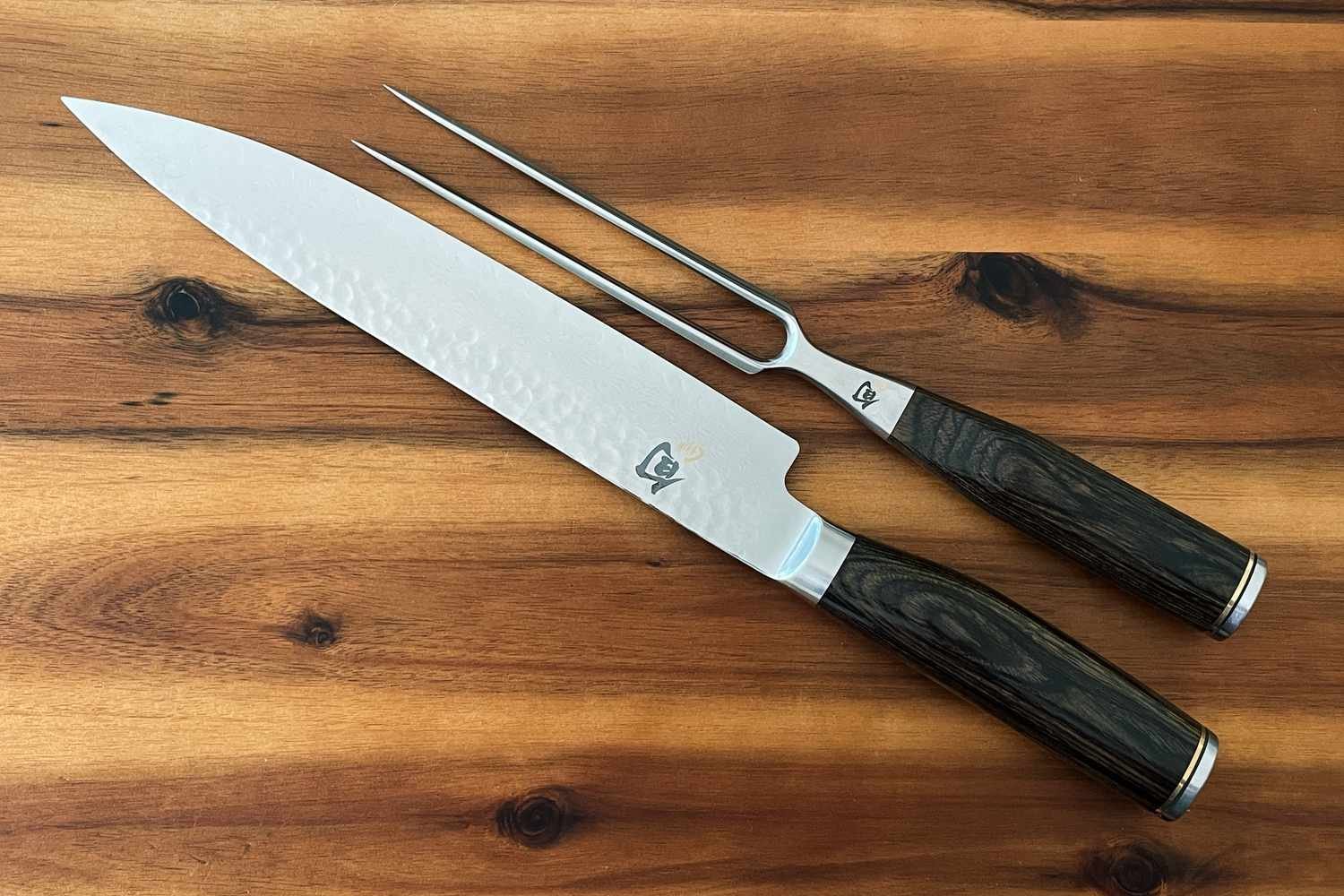
10 Best Carving Knife
Meat Carving Knives A dedicated slicer helps you serve neat portions of hot meat quickly without shredding your dinner.
Dinner guests are sitting at the table while your roast chicken loses heat on the counter. The skin tears because your chef knife is too thick to slide through without pulling. You end up sawing at the breast, and the juices spill out onto the wooden board instead of staying inside the portions.
A good meat slicer prevents that mess because it glides through cooked meat in long strokes. Finding the best carving knife means matching blade length and shape to the meats you cook most often. Below, you’ll find eight strong options to help you choose the best carving knife for your own kitchen.
1. WÜSTHOF Classic 9″ Carving Knife
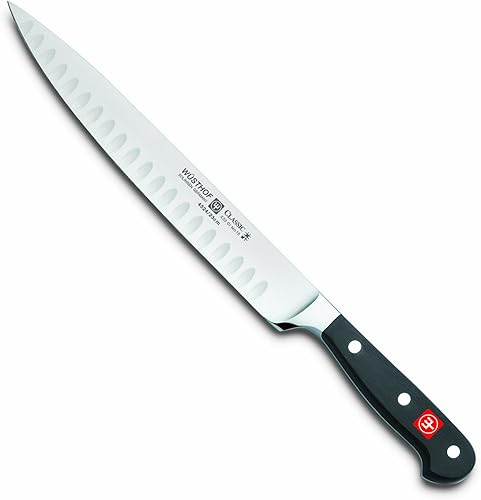
Best for: cooks wanting a pointed blade for whole birds
This German knife has a 9-inch high-carbon stainless steel blade tempered to 58 HRC. It features a pointed tip designed to guide meat away from bones, plus vertical hollows to create air pockets. The synthetic handle uses triple rivets and a full bolster with a finger guard.
The pointed design helps trace around turkey joints, but the full bolster makes running the entire edge over a flat sharpening stone harder. It isn’t for buyers carving giant briskets because nine inches won’t cover broad cuts in a single pull.
Pros: – Pointed tip guides meat away from bone – Triple-riveted synthetic handle resists fading and impact – Hollow edge indentations reduce food sticking – Full finger guard protects your hand
Cons: – Full bolster limits whole-blade sharpening – Nine inches won’t slice extra-wide roasts
Why this one: Choose this model if you roast whole birds or bone-in meats and need precise tip work. Look at longer slicers instead if you frequently carve flat beef briskets.
2. Victorinox Fibrox Pro Slicing Knife

Best for: pitmasters who slice giant hot barbecue briskets
This knife gives you a 12-inch high-carbon stainless steel blade with a rounded tip and a Granton edge. The handle uses textured Fibrox Pro material shaped for a non-slip grip when handling greasy foods. It meets National Sanitation Foundation standards for food contact safety.
The 12-inch span gives you smooth slicing across big briskets, but the long length makes standard kitchen storage difficult.
Pros: – Long 12-inch blade cuts roasts in one pull – Non-slip handle stays secure with wet hands – Granton hollows improve separation from meat – Certified to strict public health sanitation standards
Cons: – Round tip profile – Extra length takes up substantial drawer space
Why this one: Pick this tool if you smoke briskets or carve huge boneless roasts in simple passes. Choose a pointed knife if you plan to carve whole turkeys instead.
3. ZWILLING Pro 8-inch Razor-Sharp German Carving Knife

Best for: home cooks who use a pinch-grip cutting technique
Built from special-formula high-carbon steel, this knife has an 8-inch blade that’s ice-hardened using the FRIODUR process. It has a curved bolster designed to let your fingers rest naturally on the steel. The handle features a full tang with three rivets.
The curved bolster helps your control, but the 8-inch blade limits the slice width on large holiday hams. This tool isn’t for slicing wide barbecue briskets because the shorter edge forces a back-and-forth sawing motion.
Pros: – Curved bolster promotes a secure pinch grip – Ice-hardened blade maintains sharpness through heavy use – Full tang provides balanced everyday cutting control – Fully forged from a single piece of steel
Cons: – Shorter blade limits single-stroke reach
Why this one: Grab this model if you want an easy pinch grip for slicing modest everyday roasts. Look at longer blades if you carve massive proteins for gatherings.
4. Dalstrong 12″ Carving and Slicing Knife
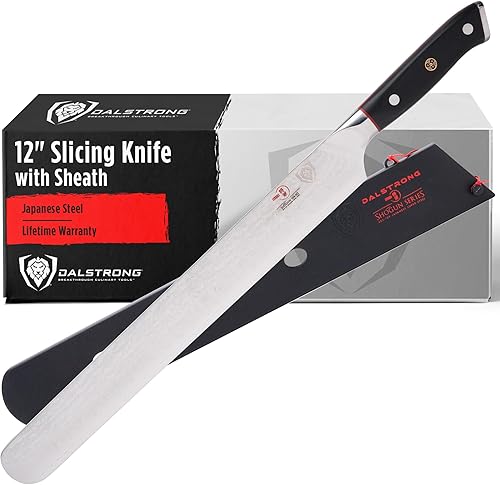
Best for: cooks slicing cured meats paper-thin for holiday boards
This large slicer uses Japanese AUS-10V steel tempered to 62+ HRC with Granton hollows ground into both faces. Dalstrong packages it with a fitted sheath and a magnetic box. The blade spans generous length for continuous cuts through delicate proteins.
The hard steel allows thin cuts of cooked meats and delicate proteins. It isn’t for buyers working in cramped kitchens with small cutting boards.
Pros: – Hard 62+ HRC steel takes very fine edges – Granton hollows prevent moist proteins from folding – Extended blade slices wide roasts cleanly – Ships with a dedicated protective storage sheath
Cons: – Very long blade demands large cutting boards
Why this one: This model suits cooks wanting deli-thin slices of salmon or boneless beef roasts. Avoid it if you need a tough blade to hack near bones.
5. Mercer Culinary M20410 Genesis 10-Inch Carving Knife

Best for: home cooks who prioritize a comfortable rubbery grip
This 10-inch carving knife is precision-forged from German high-carbon steel with a taper-ground edge. It carries a soft-grip ergonomic handle that maintains traction even when greasy. The manufacturer notes it should be hand-washed with mild soap and dried immediately.
The textured handle keeps your hand steady during long carving sessions. It isn’t for cooks who want dishwasher-safe cutlery because submersion can harm the handle.
Pros: – Taper-ground edge cuts cleanly through poultry – Soft ergonomic handle stops slips when wet – Forged construction from durable German steel – 10-inch length balances control and reach
Cons: – Requires careful hand-washing and quick drying
Why this one: Pick this knife if you want an ergonomic, non-slip grip even when your hands are wet. Look elsewhere if you demand Granton pockets or dishwasher convenience.
6. HENCKELS Classic Razor-Sharp 8-inch Carving Knife

Best for: buyers wanting simple upkeep and fast cleaning
Featuring an 8-inch satin-finished blade, this knife uses fully forged German-engineered construction. Fully forged construction offers durability and a seamless transition from blade to handle. The manufacturer states it’s rust-free and dishwasher-safe for convenient cleanup.
Its compact length handles poultry easily, but shorter edges won’t slice a standing rib roast without sawing back and forth. It isn’t for pitmasters carving large proteins because the short reach tears meat bark.
Pros: – Dishwasher-safe construction allows fast cleaning – Fully forged blade provides lasting kitchen durability – Lightweight build reduces hand strain during prep – Satin finish resists surface staining and rust
Cons: – Compact blade runs short for holiday roasts
Why this one: Take this pick if you want a reliable everyday slicer that doesn’t mind a dishwasher cycle. Pass on it if you routinely carve wide briskets.
7. Cutluxe Brisket Knife

Best for: cooks wanting a long blade with wooden styling
This slicer offers a 12-inch Granton blade forged from German steel rated at 56+ Rockwell hardness. The blade is ground to a 14-16 degree edge per side. It features a laminated pakkawood handle with triple rivets and includes a storage sheath.
The extra-long blade handles large briskets smoothly with its razor-sharp Granton edge. It isn’t for small chicken carving because the long blade feels unwieldy around small carcasses.
Pros: – Hand-sharpened 14-16 degree angle gives clean cuts – Full-tang pakkawood handle provides attractive balance – Granton indentations prevent sticking on smoked meats – Protective blade sheath included in the box
Cons: – Extra-long blades feel clumsy for small poultry
Why this one: Buy this knife if you want a handsome pakkawood-handled tool for slicing barbecue roasts. Choose a pointed nine-inch knife if you mainly carve small birds.
8. Cutluxe 9-Inch Carving Knife
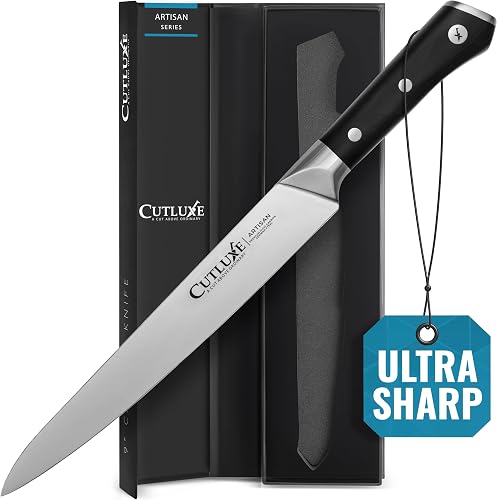
Best for: cooks needing a shorter wood-handled roast slicer
This 9-inch knife features German high-carbon steel hardened to 56+ Rockwell with a double-bevel edge ground to 14-16 degrees per side. It incorporates a full tang and an ergonomic pakkawood handle held together with three rivets.
Its compact profile maneuvers easily across cutting boards. It isn’t for large barbecue briskets where a short blade might cause jagged slice marks.
Pros: – Compact 9-inch blade fits smaller cutting boards – Razor-sharp factory edge ground to 14-16 degrees – Triple-riveted pakkawood handle offers strong stability – Forged German steel resists staining and rust
Cons:
- A 9″ blade means anyone carving in tighter spaces has to plan around that reach.
Why this one: Select this model if you carve simple family roasts and prefer pakkawood styling. Pick a Granton-edged tool if you slice sticky smoked meats.
Also Worth Considering
- Victorinox Cutlery Carving Knife: This 8-inch knife features a stiff blade paired with a black Fibrox handle, making it a compact utility alternative for smaller boneless poultry carving tasks.
- Mercer Culinary M23011 Millennia Black: Built with an 11-inch slicer profile, this model provides extra cutting length for cooks who want a longer stroke on broad roasts.
- HENCKELS Statement Razor-Sharp Slicing Knife: This 8-inch slicing knife utilizes German engineering and a modern black and stainless-steel handle for daily boneless carving prep.
How to Choose Yours
Select your knife based on how you cook rather than chasing the longest blade. Match the tool to your cutting board size and typical proteins.
- Do you carve whole bone-in turkeys or large boneless briskets?
- Will such a long knife fit safely inside your kitchen drawers?
- Do you prefer washing knives by hand or using the dishwasher?
- Is your cutting board large enough for long, sweeping knife strokes?
- Do you slice wet proteins that stick to flat metal blades?
- Do you need a pointed tip to work around joint bones?
The Verdict for Most People
Most cooks will be happiest with the Wusthof Classic Carving Knife. Its 9-inch profile balances overall control with ample reach, and the pointed tip easily separates whole turkey joints from the carcass. The forged bolster and hollow-edge pockets keep food from clinging to the blade during holiday dinners.
If you regularly smoke large beef briskets or pork loins, choose the Victorinox Fibrox Pro Slicing instead. Its extended Granton blade lets you pull through wide meats in a single clean pass without tearing. Whichever you select, picking a blade tailored to your meats makes serving dinner effortless.
Frequently Asked Questions
What blade length should I get for my kitchen?
Choose an 8-inch or 9-inch blade for chickens, small turkeys, and standard pork loins. If you carve whole beef briskets, prime rib roasts, or large holiday hams, pick a 10-inch or 12-inch blade. The longer edge lets you cut wide meats in one motion without pulling back and forth.
Do I need to sharpen my knife before first use?
No, factory carving knives arrive sharp enough to slice cooked meat straight from the box. You only need to wash the blade with warm water and soap before touching food. Reviewing standard kitchen protocols from the NSF food safety standards helps you maintain a sanitary food prep area before your first holiday meal.
How do I keep this blade sharp over time?
Hone the edge with a smooth ceramic or steel rod every few uses to keep it straight. Wash the blade by hand with mild dish soap, dry it completely, and avoid leaving it in a wet sink. Store it inside a protective sheath or knife block so hard objects don’t dull it.
Are long slicing knives safe to use at the table?
Yes, but you must keep your non-knife fingers tucked inward like a claw while holding the meat. Use a carving fork to steady the hot roast instead of holding it directly with bare hands. Never force the blade through bones, as slipping causes kitchen accidents.
Is a carving knife worth buying over a chef knife?
Yes, a carving knife is thinner and narrower, which reduces friction against hot meats. A standard chef knife is thicker and tends to pull on meat fibers, causing messy, shredded slices. The narrow profile preserves tasty juices and delivers uniform slices on family dinner platters.





One Comment