10 Best Boning Knife
You stand at the cutting board with a whole chicken or a thick roast, trying to separate meat from bone with an ordinary chef knife. The wide blade wedges against the joints, slips off cartilage, and leaves good meat stuck to the carcass. That frustrating mess is what drives most cooks to look for the best boning knife.
Choosing the right tool is rarely simple because you must weigh blade flex against overall stiffness. A stiff blade powers through tough joints on beef and pork, while a flexible knife bends neatly around small poultry ribs and fish skin. This guide covers how these knives differ so you can pick the right shape and steel for your kitchen counter.
1. Victorinox Fibrox Pro

Right for: Cooks wanting a curved semi-stiff blade for basic butcher work.
The listing names this as a 6-inch curved boning knife built with a semi-stiff blade and a Fibrox Pro handle. It gives no other technical details, steel grades, or manufacturing specifications.
Because the listing provides only the title, buyers get a dedicated profile without extra published claims to verify. The curved shape helps you work around bones, but anyone wanting confirmed steel hardness or warranty terms won’t find them here.
What works: – Curved 6-inch blade format – Semi-stiff blade profile – Fibrox Pro handle
Where it gives ground:
Skip it if: You require verified steel specifications before buying your prep tools.
2. WÜSTHOF Classic 5″ Boning Knife

Right for: Cooks wanting heavy German steel for dense beef and pork.
Wüsthof builds this 5-inch knife from a single block of high-carbon stainless steel tempered to 58 HRC. The listing highlights full-tang construction, triple-riveted synthetic scales, PEtec edge sharpening, and a limited lifetime warranty from Solingen, Germany.
The narrow 5-inch blade offers direct leverage along dense joints, though the shorter reach requires extra strokes on large roasts. It isn’t built for filleting whole flatfish because the rigid German profile won’t bend across wide, flat rib cages.
What works: – Forged high-carbon steel at 58 HRC – Triple-riveted full-tang handle design – Limited lifetime warranty protection – Narrow curved blade profile
Where it gives ground: – Compact 5-inch length limits single-stroke reach
Skip it if: You need a long, bendable blade for skinning large fish fillets.
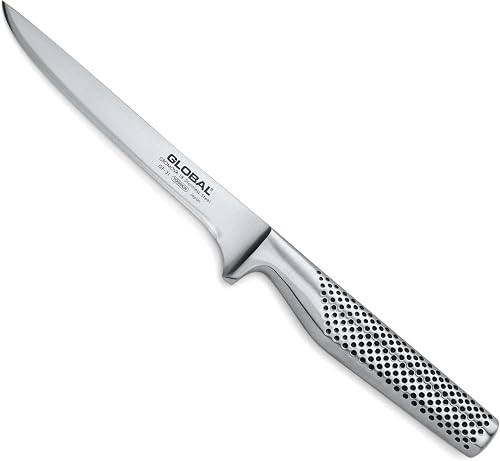
3. Global GF-31-6 1/4 inch
Right for: Cooks who prefer a rigid, all-metal heavyweight knife.
Global specifies a 6-1/4-inch stiff blade made from molybdenum/vanadium stainless steel paired with a dimpled metal handle. The listing states the knife is precisely balanced, retains a sharp edge, and carries a lifetime warranty against defects.
The heavier build gives you stability when pushing past tough cartilage on poultry and pork carcasses. However, the dimpled steel handle lacks the soft cushioning of rubberized grips during long processing sessions.
What works: – Stiff molybdenum and vanadium steel blade – Molded handle with textured dimples – Solid heavyweight balanced construction – Lifetime warranty against defects
Where it gives ground: – All-stainless-steel handle construction
Skip it if: You prefer a cushioned, rubberized handle for long butchery jobs.
4. ZWILLING Pro 5.5-inch Razor-Sharp German Flexible Boning Knife

Right for: Buyers needing flexible German steel with an ergonomic curved bolster.
This 5.5-inch knife features ice-hardened FRIODUR stainless steel forged from a single piece, alongside a curved bolster and triple-riveted full tang. Zwilling notes laser-controlled edge angles, dishwasher-safe maintenance, and German factory manufacturing.
That curved bolster guides your fingers into a pinch grip, giving you clean control when tracing small ribs. The flexible blade won’t chop through heavy connective joints, meaning you can’t force it through thick bone structure.
What works: – Ice-hardened flexible FRIODUR steel – Ergonomic curved bolster design – Full tang with triple rivets – Dishwasher-safe construction
Where it gives ground: – Flexible steel can’t handle heavy joint hacking
Skip it if: You need a rigid blade to pry apart thick beef knuckles.
5. Dalstrong 6″ Boning Knife

Right for: Detail trimming, silverskin removal, and delicate poultry joints.
Dalstrong builds this 6-inch knife with a 66-layer Damascus AUS-10V core rated at 62+ HRC. The listing details a flexible tip for sliding under silverskin, a G10 composite handle, a protective sheath, and a magnetic gift box.
The hard 62+ HRC edge lets you shave membranes off tenderloins with minimal meat loss. That higher hardness means the steel is more brittle than softer German steel, so prying bones can cause edge chipping.
What works: – AUS-10V core at 62+ HRC – Sixty-six layer Damascus steel cladding – Flexible tip for peeling silverskin – Includes matching fitted protective sheath
Where it gives ground: – Hard edge risks chipping if twisted against bone
Skip it if: You want soft, forgiving steel that tolerates rough bone twisting.
6. Mercer Culinary Ultimate White
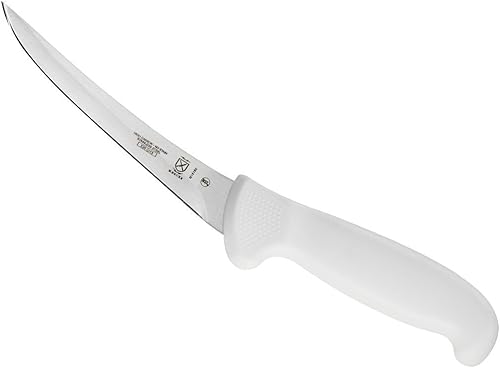
Right for: High-volume kitchen prep needing textured, non-slip handle safety.
Mercer uses high-carbon Japanese steel for this 6-inch curved knife, pairing it with an ergonomic handle featuring raised finger points. The maker specifies hand washing with warm water and soap while advising against dishwashers or water submersion.
The textured points give you a firm grip even when chicken fat and moisture coat your hands. Because the listing explicitly forbids dishwasher cleaning, maintaining the blade requires dedicated hand washing after every single use.
What works: – High-carbon Japanese steel blade – Textured non-slip raised finger points – Curved profile separates meat smoothly – Built for high-volume prep work
Where it gives ground: – Hand washing required to prevent damage
Skip it if: You wash all your kitchen prep tools exclusively in a dishwasher.
7. Wüsthof Classic Ikon 5″ Boning Knife

Right for: Home butchers who prioritize balance and dual-bolster handle comfort.
This German-made 5-inch knife utilizes high-carbon stainless steel hardened to 58 HRC, featuring a distinct double-bolster handle and PEtec edge. Wüsthof covers the knife with a limited lifetime warranty and highlights its narrow curved shape for pork, beef, and poultry.
The rear bolster shifts physical weight back into your palm, keeping your hand fresh through repeated cuts. It shares a more compact blade profile, so slicing across wide beef briskets requires extra trimming passes.
What works: – Dual bolsters provide refined balance – Solingen high-carbon steel at 58 HRC – Precision PEtec edge retention technology – Backed by limited lifetime warranty
Where it gives ground: – A shorter, more agile blade limits large protein slicing
Skip it if: You frequently break down large game requiring long blade strokes.
8. Victorinox Swiss Classic 6-Inch Boning Knife with Narrow

Right for: Processing small poultry and fish using an S-shaped flexible edge.
Victorinox fits this Swiss-made knife with a thin, flexible 6-inch blade featuring an S-shaped edge and an NSF-approved handle. The listing notes it reduces wrist tension, carries a lifetime warranty, and ships stamped with model number 6.8413.15.
The thin, bendable metal easily hugs chicken breast bones, yielding very little meat waste on small carcasses. However, this flexible profile isn’t suitable for split beef shanks, as the thin blade bends under heavy lateral pressure.
What works: – Thin flexible S-shaped blade design – NSF-approved wrist-comfort handle – Swiss manufacturing with lifetime warranty – Lightweight profile for nimble slicing
Where it gives ground: – Thin steel bends under heavy butcher pressure
Skip it if: You regularly split heavy pork cuts or dense beef connective joints.
9. HENCKELS Forged Premio 5.5-inch Boning Knife

Right for: Everyday kitchen cooks wanting a forged bolster and stainless endcap.
Henckels constructs this 5.5-inch knife from German stainless steel using forged bolster manufacturing in China, finishing it with a logo-stamped metal endcap. The listing highlights a satin-finished edge and triple-riveted curved handle.
The solid bolster creates a smooth physical bridge between the blade and handle, stopping hand strain during routine chicken prep. The satin-finished blade provides precision cutting for everyday poultry and meat prep.
What works: – Durable forged bolster transition – Traditional triple-rivet curved handle – Sturdy stainless steel logo endcap – Fully dishwasher-safe maintenance
Where it gives ground:
Skip it if: You require a dedicated flexible tip for skinning thin fish fillets.
10. HOSHANHO Fillet Knife 7 Inch

Right for: Slicing, scaling, and skinning fresh whole fish and poultry.
Hoshanho pairs a 7-inch thin blade made from 10Cr15CoMoV Japanese stainless steel with a water-resistant pakkawood handle. The listing specifies a 15-degree hand-polished edge per side, lightweight balance, and flexible geometry for scaling, filleting, and butterflying.
At 7 inches long, the blade glides cleanly along fish backbones in one steady, continuous motion. The 7-inch blade is longer than standard boning profiles, which gives it extra reach when working along fish bones.
What works: – Long 7-inch 10Cr15CoMoV stainless blade – Polished 15-degree cutting angle per side – Natural moisture-resistant pakkawood handle – Flexible geometry for butterflying fish
Where it gives ground: – Seven-inch length feels awkward in tight spaces
Skip it if: You only trim small chicken wings or tight quail joints.
Also Worth Considering
The Victorinox Wood Boning Knife gives you a mid-length curved semi-stiff blade paired with a natural maple handle for cooks who dislike synthetic grips. The Shun Boning Fillet Knife delivers an alternate Japanese profile focused on dual-purpose trimming and filleting tasks. The Cutluxe Boning Knife provides a standard razor-sharp boning format intended for general meat cutting and slicing.
How to Think Before You Choose
Blade Flexibility Versus Rigid Strength
Flexible blades bend to follow curved ribs, which saves meat when you skin fish or trim poultry breasts. Rigid blades stay completely straight, giving you the physical leverage needed to pry joints apart on beef, pork, or lamb carcasses. Look at the meat you buy most often: if you process whole birds or fish, pick a flexible blade; if you split heavy pork roasts, choose stiff steel.
Curved Edge Versus Straight Geometry
A curved blade lets your hand work at a comfortable angle while keeping the sharp tip pressed tight against flat bone surfaces. A straight blade works like a compact carving knife, making it simple to trim external fat caps or slice meat into uniform portions. Check your cutting board height at home to see if your wrist stays straight when pointing a knife downward.
High Hardness Versus Impact Toughness
Hard steel rated above 60 HRC takes a very thin, sharp edge that glides through meat and removes silverskin without tearing. Softer steel around 56 to 58 HRC resists chipping when it accidentally strikes hard bone structures. For professional hygiene standards, look for handles certified by the NSF public health foundation before buying equipment for heavy kitchen use.
Who Should Skip These Altogether
- Cooks who buy only pre-cut boneless chicken breasts and steaks never need a dedicated boning knife.
- Anyone owning a sharp utility knife can trim light fat caps without buying an extra tool.
- People looking to cleave through hard soup bones need a heavy meat cleaver instead.
- Casual cooks who break down one chicken a year won’t benefit from storing a single-purpose butcher blade.
The Victorinox Fibrox Pro handles general poultry and meat cutting for most kitchens, while the Dalstrong AUS-10V gives you the hard, fine edge needed for intricate silverskin removal. Check the meats you cut most often this week, then select the blade stiffness that fits your cutting board.
Frequently Asked Questions
Can I sharpen these knives with a regular pull-through sharpener?
You shouldn’t run these specialized edges through pull-through sharpeners. Knives like the Dalstrong AUS-10V use hard steel and narrow angles that chip in aggressive carbide slots. Use a fine ceramic honing rod or flat whetstone to preserve the factory bevel without stripping away good steel.
Can I wash my boning knife in the dishwasher?
Most boning knives should stay out of the dishwasher entirely. While models like the Zwilling Pro are labeled dishwasher safe, hot wash cycles and harsh detergents dull fine edges. Mercer Culinary explicitly instructs users to wash cutlery by hand and avoid the dishwasher.
What causes a boning knife edge to chip?
Edges chip when hard steel twists against dense bone or frozen joints. A knife like the Dalstrong AUS-10V is hardened to 62+ HRC, which makes the metal less ductile under sideways torque. Never twist the blade sideways inside a socket joint; use clean slicing pressure along bone contours instead.
Is an entry-level commercial knife good enough for home butchery?
A commercial tool like the Mercer Culinary Ultimate is more than enough for processing everyday meats. It offers durable Japanese steel and a non-slip handle designed for commercial kitchens. You do not need multi-layer Damascus steel just to debone chicken legs or trim standard pork fat.
What should I check on my cutting board before choosing a blade?
Make sure your cutting surface is wood or soft plastic, and measure your clearance. A 7-inch knife like the Hoshanho Japanese Fillet requires a spacious cutting board so the tip doesn’t catch on edges. Hard surfaces like glass, granite, or ceramic countertops will ruin these thin edges instantly.