Can You Put a Treadmill Upstairs
So, can you put a treadmill upstairs? Yes, but only if your floor structure can take the load. Most upstairs rooms in US homes use wooden floor joists, and those joists have real limits.
Per the International Residential Code, standard residential floors are designed for 40 pounds per square foot. A 300-pound treadmill plus a 200-pound runner concentrates more than that in a small area. That's why placement matters so much.
Good news: a few simple checks can tell you if your floor is up to it.
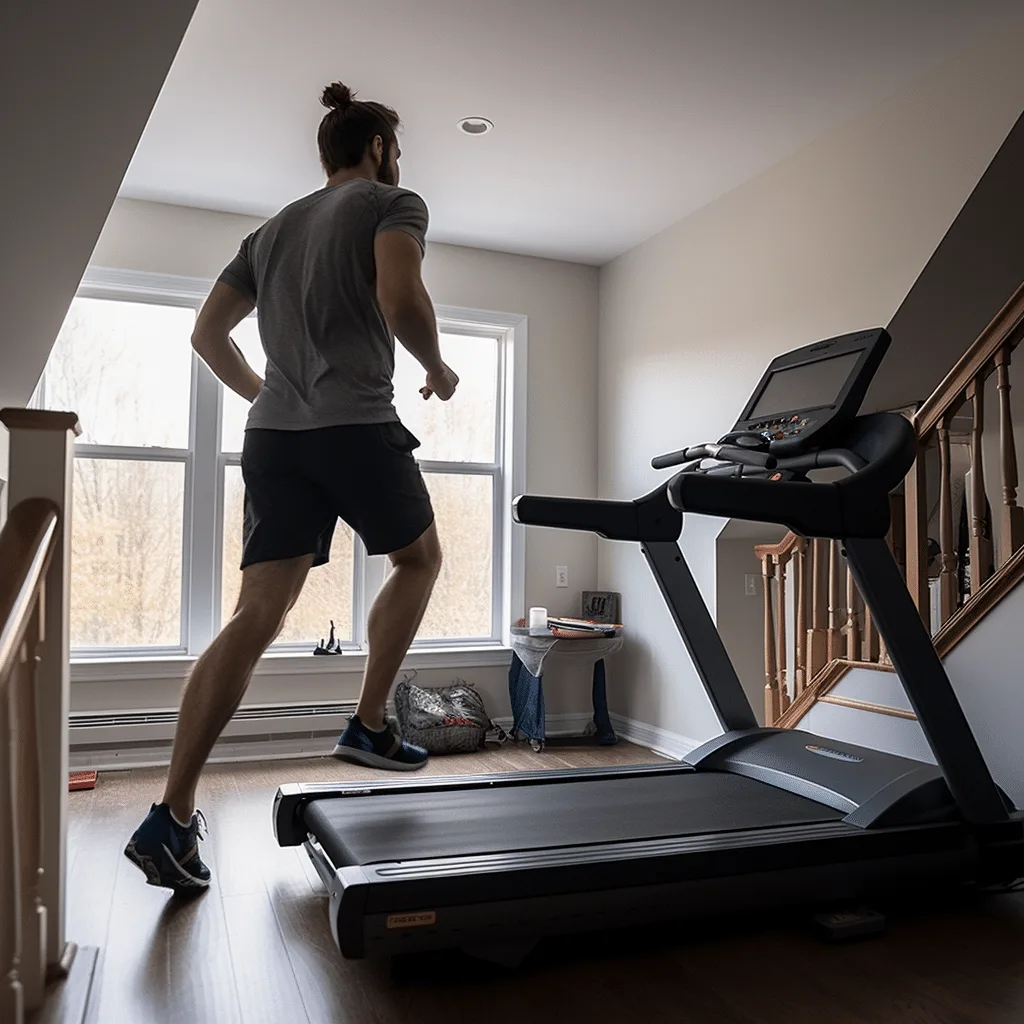
Image source: Bing (Web (fair-use with source credit))
Quick Answer
Yes, but the floor has to support the load. Running adds up to 2.5 times your body weight. Place the treadmill near a load-bearing wall.
Check joist size and span first.
Can You Put a Treadmill Upstairs? The Short Answer (and Why It's Not Just About Weight)
Yes, many homes can handle a treadmill upstairs. But the numbers that matter are more than just the machine's weight on the box. Your weight, your running style, and your floor build all change the equation.
Impact load is the big one. When you run, each footfall can hit the floor with 2.5 times your body weight. A 180-pound runner creates impact spikes around 450 pounds per stride.
That concentrated force is what causes bounce, creaks, and sagging over time.
Manufacturer weight ratings describe how much weight the treadmill belt can carry, not what the floor can take. Use the treadmill's static weight plus your body weight as the floor load baseline. Then multiply for running impact.
This isn't a scare tactic. It's just math. Floors are engineered with safety factors, so most homes won't fail.
But you want to avoid long-term damage.

Image source: Bing (Web (fair-use with source credit))
What Actually Determines Whether Your Floor Can Handle It
Three things matter most: joist size, joist spacing, and span length.
Joists are the horizontal beams under your subfloor. In most US homes, they're 2×8, 2×10, or 2×12 lumber, spaced 16 inches on center. The span is the distance the joist travels between supports (like bearing walls or beams).
Longer spans flex more. A 2×10 spanning 14 feet moves noticeably more than one spanning 8 feet.
Static Weight vs. Impact Load: Why Running Hits Harder Than Standing
The middle of a joist span is the weakest point. The area near a bearing wall is the strongest. Put the treadmill perpendicular to the joists so it crosses several at once.
That spreads the load far better than lining it up parallel.
Where the Treadmill Sits on the Span Matters More Than You Think
A treadmill's four feet press down on the subfloor in small spots. Each foot might carry 150 to 400 pounds during a run. If the floor is plywood over joists, the joists carry that load to the walls.
The issue is when a single joist absorbs too much weight in its weakest spot.
You can check your joist configuration using the American Wood Council's span tables. Those tables list maximum spans for each joist size and spacing. If your joists are near the edge of the allowed span, a treadmill may push them closer to their limit.
How to Check Your Floor Like a Pro (Before You Drag Anything Upstairs)
You don't need to hire an engineer for your first check. Start with simple observations and the water-glass test.
Set a glass of water on the floor where the treadmill will go. Jog in place next to it for 10 seconds. If the water ripples visibly or the floor feels springy, that's a red flag.
Listen for creaks too. Creaks often mean the subfloor is separating from the joists.
Quick Tests: Bounce, Sag, and the "Water Glass" Trick
Use a basketball as a second test. Drop it from waist height in different spots. Higher bounces suggest a firmer floor.
A thud or a low bounce in the middle of a room often points to a weaker spot.
Reading Joist Direction and Span from the Ceiling Below
Go to the room beneath the treadmill spot. Look at the ceiling for nail pops, drywall seams, or cracks. Those lines often trace the joist direction.
If you have access to the basement or the floor below, you can see the joists directly and measure their size.
Placement Rules: Perpendicular to Joists, Near a Load-Bearing Wall
Follow these placement rules if you decide to move forward:
- Place the treadmill perpendicular to the joists.
- Keep it within 18 inches of a load-bearing wall.
- Avoid the center of the room.
- Leave at least 3 inches of clearance behind the machine for airflow.
The Decision Tree: Yes, No, or "Only in This Exact Spot"
Here's a practical decision tree based on your floor type.
| Floor type | Verdict |
|---|---|
| Concrete slab or engineered trusses | Yes, place anywhere |
| 2×10 or 2×12, span under 12 ft | Likely yes, keep near bearings |
| 2×10 or 2×12, span over 12 ft | Conditional, consider reinforcement |
| 2×6 or older framing | Likely no, move to ground floor |
Branch 1: You Have Concrete or Engineered Joists — Likely Fine
Concrete slabs don't bounce. Engineered I-joists and open-web trusses are stiffer than sawn lumber. If your home was built in the last 20 years with engineered floors, the risk is low.
Place the machine wherever you prefer.
Branch 2: You Have 2×10 or 2×12 on 16" Centers — Proceed Cautiously
This is the standard for modern US construction. Check the span. If your floor feels solid in the water-glass test, you're probably fine near the wall.
If it feels live or bouncy, consider a lower-impact machine like an elliptical or a walking pad instead.
Branch 3: You Have 2×6, Long Spans, or Bouncy Floors — Stop and Rethink
Older homes with 2×6 joists often can't handle a running treadmill. A walking treadmill might be okay if you stay at a moderate pace. A running treadmill is a bad bet.
Move it to a concrete floor or reinforce the structure first.

Image source: Bing (Web (fair-use with source credit))
Common Mistakes That Lead to Creaky Floors, Cracks, and Regret
People make the same three mistakes nearly every time. Avoid these and your floor will hold up far better.
Putting the Treadmill in the Middle of a Span
The center of a room between supports is the weakest point on any floor. Larger homes often place the treadmill in the middle for looks. That's the worst spot.
Move it closer to a wall, even if it doesn't look as nice.
Skipping the Mat, or Buying One Too Thin
A rubber mat won't fix structural problems, but it does dampen vibration and protect the floor. Use at least 5mm thickness. Thinner mats mostly protect against sweat and scratches, not noise.
An 8mm mat is better for vibration. Add a quick cleaning routine to keep the area fresh, especially if the machine sits near a bedroom or closet.
Assuming the Weight Listed on the Box Is What Your Floor Feels
The static weight on the spec sheet is only part of the story. Your body weight adds to it. Running multiplies the total.
A 300-pound treadmill and a 200-pound runner can push over 1,000 pounds of force through a small contact point during a run.
Still Unsure? Here Are Your Alternatives (and When They Make More Sense)
If your floor test leaves you worried, there are alternatives. The simplest is moving to the ground floor. A basement or garage slab has zero bounce.
Basement or Garage Placement Win for Serious Runners
For serious runners who need a full-size treadmill, the ground floor is the safest answer. Concrete slabs handle impact loads without flex. You also avoid noise transfer to bedrooms below.
The downside? Maybe you have to navigate stairs or deal with a less convenient setup.
Walking Pads, Ellipticals, and Bikes: Lighter on Floors and Joints
Stationary bikes create almost no impact. Ellipticals spread the load across four points and move smoothly. Rowing machines are also low-impact.
All three are far friendlier to an upstairs floor than a treadmill.
| Equipment | Typical weight | Impact | Upstairs suitability |
|---|---|---|---|
| Full-size treadmill | 150-350 lbs | High | Conditional |
| Walking pad | 50-100 lbs | Low | Usually fine |
| Elliptical | 100-250 lbs | Very low | Good |
| Exercise bike | 75-200 lbs | None | Excellent |
Reinforcing the Floor: Sistering Joists and Support Posts
If you own the home and want the treadmill upstairs permanently, reinforcement works. Sistering adds new joists next to the old ones. A support post under the floor can also shorten the span.
This is a contractor job. Expect to pay based on access and local rates.
When to Call a Professional (and What It Costs)
You don't need an engineer for every case. But if the floor feels bouncy, if you see drywall cracks, or if you're installing a heavy commercial treadmill, call one. A structural engineer gives you a definitive answer.
The Structural Engineer's Visit: What They Check and What You Pay
An engineer will measure joist size, spacing, and span. They'll inspect connections and check for existing damage. Typical cost ranges from $300 to $600 for a residential visit.
You'll get a written load assessment, which is gold if you're requesting landlord permission or selling the home later.
DIY Reinforcement vs. Hiring a Contractor: Where to Draw the Line
Sistering joists is demanding but simple in concept. However, structural work affects safety and home value. If you're not fully confident, hire a licensed contractor.
Building permits on floor reinforcement are common. As of 2026, most municipalities require an inspection.
A Quick Word on Rental Rules, HOA Rules, and Insurance
Renters almost always need landlord approval for heavy equipment. HOAs may restrict noise transmission between units. And your homeowner's insurance could have exclusions if structural damage happens because you exceeded the floor's load rating.
Check these before installation.
FAQs: The Questions Everyone Asks When Stuffing a Treadmill Upstairs
Can a Folding Treadmill Make This More Feasible?
Yes, folding treadmills are often lighter and easier to position carefully. They typically weigh 100 to 150 pounds less than non-folding models. However, weight isn't the only factor.
Impact load from running still applies, so floor assessment remains necessary.
How Much Noise Transfer Should I Expect to the Room Below?
Some noise, especially with running. Walking generates less vibration. An 8mm rubber mat helps noticeably.
If sound is your main concern, a stationary bike or elliptical transfers far less noise than a treadmill.
If I Only Walk, Does the Risk Go Down Significantly?
Yes, substantially. Walking creates impact forces closer to your static body weight rather than the 2 to 2.5 times multiplier from running. Many floors that can't handle running can support walking treadmills without issue.
Could My Floor Collapse, or Are We Just Talking About Annoying Bounce?
Total collapse is extremely rare in code-compliant homes. The real risks are progressive damage: joist fatigue, subfloor separation, and drywall cracks. These are serious but happen gradually.
A floor that feels spongy is a warning to address, not an imminent emergency.
What Mat Thickness Actually Makes a Difference?
For vibration dampening, 5mm is the minimum. Eight millimeters or thicker is better. Mats under 3mm mainly protect against scratches and sweat.
They don't meaningfully reduce noise or impact transmission to the floor below.