How Much Space Does a Treadmill Need
How much space does a treadmill need? The honest answer is that it depends on your body, the model, and your ceiling height. A standard running treadmill takes up roughly 79 inches of floor length and 36 inches of width, but that's only the machine itself.
Manufacturer specifications confirm that you also need clearance around the belt for safe entry and exit. As of 2026, most home fitness guidelines recommend at least six feet of open floor behind the treadmill and 18 to 24 inches on either side. That extra room is what most people forget to measure.
Image source: Bing (Web (fair-use with source credit))
Why One Standard Answer Won't Work for You
Most online advice gives you one flat number: a treadmill needs about 6 feet by 10 feet. That's a decent starting point, but it falls apart the moment you factor in who's running and what you're buying.
If you're a walker using a folding treadmill, a smaller footprint may work. If you're a runner with a long stride, you need a longer belt and more rear clearance. If you're tall and you like incline training, your ceiling height becomes the deciding factor.
The space you need comes down to three things: the machine's unfolded dimensions, your natural stride, and the room's height. That's why one standard answer fails. The right approach is to map your specific situation.
You might only have a tight corner, but a compact under-desk treadmill could fit perfectly. Or you might have a spare room that's technically large enough, yet a low ceiling makes it unusable. Both are common.
In our research, the biggest mistake people make is measuring the treadmill's box dimensions instead of its actual running footprint. Let's break down the real numbers next.
The Quick Baseline: What Most Treadmills Actually Need
Here's the short answer for a typical household: allow a clear floor area of about 6 feet by 10 feet for a full-size running treadmill. That includes the machine plus the recommended empty space around it.
The table below shows the baseline measurements most manufacturers list in owner's manuals.
| Measurement | Typical Range | Notes |
|---|---|---|
| Treadmill unfolded length | 70–80 inches | From front motor hood to rear roller |
| Treadmill unfolded width | 30–36 inches | Includes side rails and console |
| Deck / belt surface | 55–60 in long, 18–22 in wide | Longer decks for runners |
| Rear clearance | At least 6 feet | Safe zone if you step off backward |
| Side clearance | 18–24 inches each side | Room to step on and off |
| Ceiling height | 8 feet minimum | 9 feet is safer for incline training |
These numbers assume a standard motorized treadmill. If you're shopping for a walking pad, you can often get away with half that footprint, but the running experience won't feel the same.
Keep this baseline in mind before you measure any room. If your space doesn't fit these minimums, you'll need to adjust your expectations or look at a different type of machine. This is also why knowing the dimensions of other home gym equipment matters when you're planning a shared space, especially if you're working around limited square footage.
It's the same principle you'd apply when figuring out how much space dumbbells need if you're setting up a corner gym.
The Three Variables That Change Everything
Your Body, Stride, and Running Style
Your height and your chosen activity determine how long the deck must be. A casual walker at 5'4" can comfortably use a 40-inch belt. A 6'2" runner needs a deck closer to 60 inches so their foot doesn't kick the front motor hood at the end of each stride.
When you run, your stride length stretches roughly 1.2 to 1.5 times your walking stride. That means the treadmill must accommodate both your footstrike and your follow-through. If the deck is too short, you'll subconsciously shorten your stride, which can lead to poor running mechanics and unnecessary strain.
If you're aggressively training for a race, this becomes a real safety issue, not just a comfort concern.
A simple test: stand with your toes at the front edge of the belt and walk backward to the rear edge. That distance should exceed your natural running stride length by at least six inches.
The Treadmill's Real Footprint vs. Box Dimensions
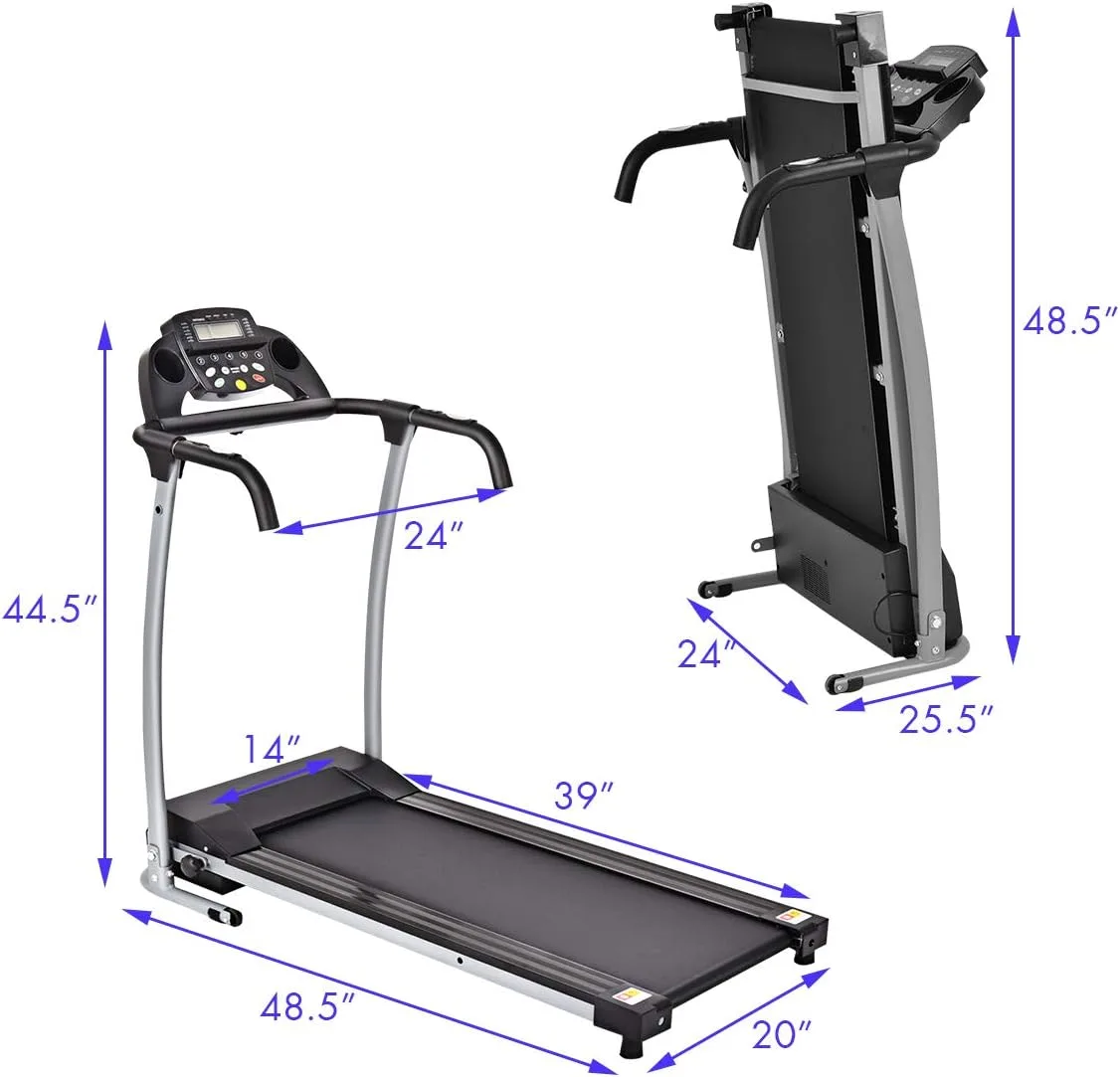
Image source: Bing (Web (fair-use with source credit))
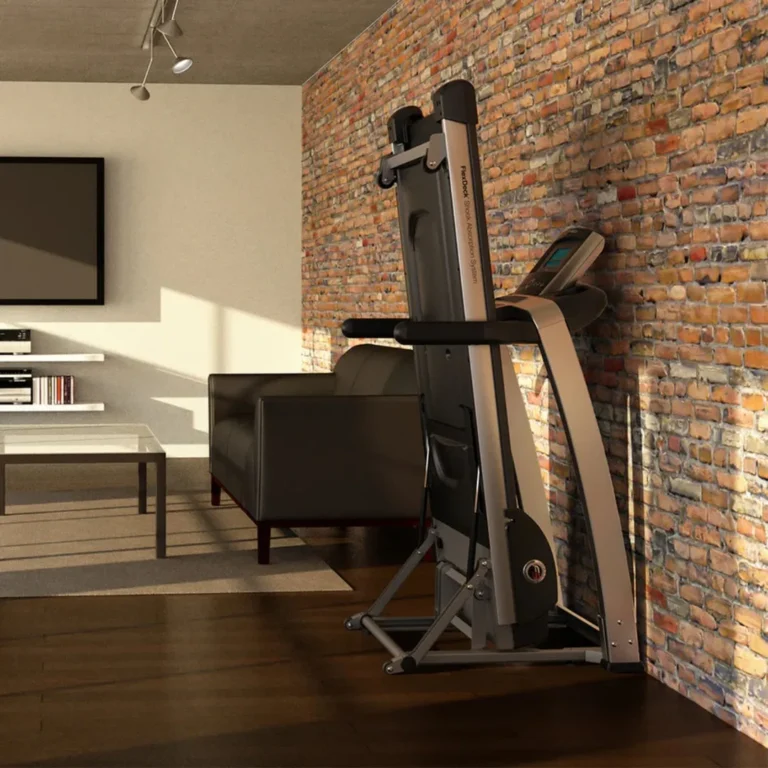
The box your treadmill ships in looks bulky, so many people assume the machine needs that entire footprint. In reality, the folded product sits vertical and takes up less floor space. The unfolded machine is what matters for daily use.
Look at the product spec sheet for the "unfolded dimensions," not the boxed shipping weight or the folded depth. The unfolded length includes the front motor hood and the rear of the frame, which extend past the belt. On many models, the belt might be 55 inches long, but the total machine length is 75 inches because of those overhangs.
Also factor in the console. Some treadmills have wide handlebars or a touchscreen that juts out. In tight spaces, the console can hit a wall when you adjust the incline, even though the deck itself has plenty of room.
Ceiling Height at Full Incline (Usually the Forgotten One)
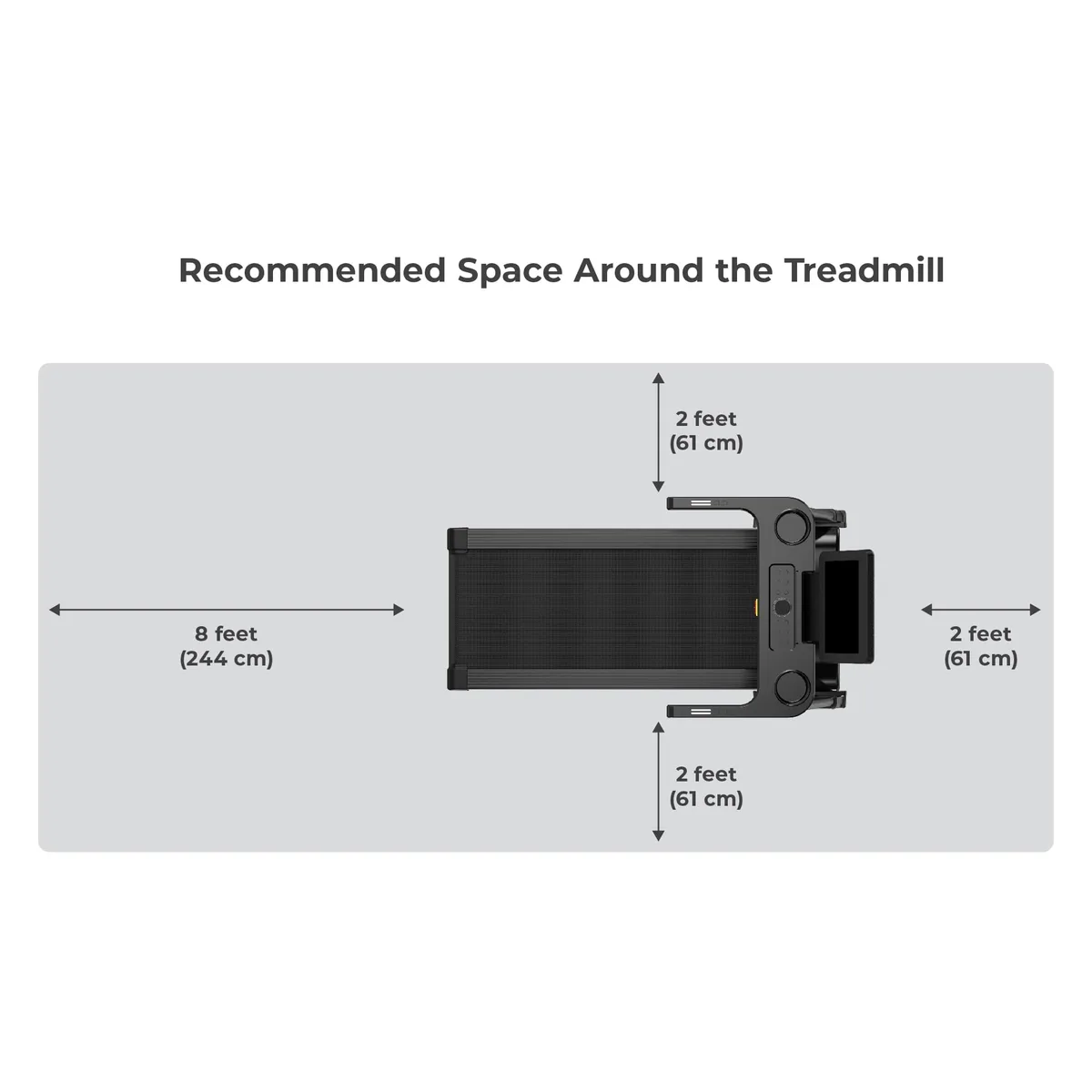
Image source: Bing (Web (fair-use with source credit))
Here's the variable almost everyone misses. When a treadmill raises to a 10 or 12 percent incline, the deck tilts upward, and your head moves closer to the ceiling. A standard 8-foot ceiling works for most people.
But a tall runner on an incline trainer can come dangerously close to hitting the ceiling at the top of their stride.
The math is straightforward. The front of the treadmill rises by roughly 15 to 20 inches at maximum incline, depending on the model and the deck length. If you're over 6 feet tall, you're already close to a standard ceiling height.
Add the upward jolt of a running gait, and you've got a real risk of injury.
Measure your ceiling before you commit. This is the same kind of clearance thought you'd put into other tall equipment. If you're considering a different cardio setup, understanding the vertical footprint can help you decide between an exercise bike and a treadmill in a room with low beams.
Your head should never be within a foot of the ceiling when the treadmill is fully inclined.
Treadmill Type by Space: Full-Size, Folding, and Walking Pads
Different designs have very different space demands. Here's how they stack up:
| Type | Unfolded footprint | Best for |
|---|---|---|
| Full-size non-folding | 6 ft × 10 ft with clearance | Serious runners, dedicated gym rooms |
| Folding treadmill | Same when in use, smaller when stored | Multi-purpose rooms, apartments |
| Under-desk walking pad | 4 ft × 2 ft | Walkers, office setups, people under 5'6" |
| Curved manual treadmill | Similar to full-size | Sprint intervals, no electricity needed |
A folding treadmill sounds like the answer to small spaces, but there's a catch. It still needs the full clearance when you're using it. The folding mechanism only helps after your workout.
If your room is 5 feet wide, a folding treadmill doesn't solve the problem.
Walking pads are the most compact option. Many are under 48 inches long and 20 inches wide. They're great for slow walking, but most aren't suitable for running.
Their belts are short, and the motors are weak. If you plan to jog, don't buy one based on space savings alone.
Curved manual treadmills occupy a similar footprint to motorized models, but they often need a little more rear clearance because you control the belt with your stride. That means the belt continues moving if you step off unexpectedly, so a longer safety zone matters.
If you're debating between a treadmill and something like an elliptical, the space comparison isn't always obvious. An elliptical has a fixed footprint that doesn't change with the user's stride. A treadmill's usable space grows with the runner.
That's one of the reasons people compare the two before committing to a purchase.
How to Test Your Room Before You Buy: A Practical Walkthrough
You don't need a tape measure and a prayer. Use this simple process to check whether a treadmill will work in your space.
- Measure the room's length, width, and ceiling height. Write down actual numbers, not guesses.
- Measure every doorway, hallway, and stair landing between the entrance and the room. The treadmill needs to get into the house before it can be used.
- Mark the exact treadmill footprint on the floor with painter's tape. Include the machine's overhangs, not just the belt.
- Add the clearance zones. Tape off 18, 24 inches on each side and at least 6 feet behind.
- Check the ceiling at full incline. Hold a broom handle at the height where the treadmill's front would rise, then stand under it and simulate your stride.
- Test your natural running stride inside the taped boundary. If your foot lands near the back edge of the marked belt, you need a longer deck or a bigger room.
- Look at outlet placement. Treadmill cords are usually 6 to 8 feet long. Avoid extension cords whenever possible.
This process takes about 20 minutes. It will save you the headache of a delivery crew hauling a 300-pound machine into a room that doesn't fit.
Don't forget the floor itself. Carpets can generate static and trap heat. Hardwood floors need a treadmill mat to prevent scratches and reduce vibration.
And always level the machine after it's in place. A treadmill that rocks even slightly will be harder on your knees and joints.
Clearance Rules: The Minimums That Keep You Safe
Clearance is the empty space around the machine. It's not wasted floor. It's what keeps you safe when you step off at speed.
| Clearance zone | Minimum | Why it matters |
|---|---|---|
| Behind the treadmill | 6 feet | Safe dismount if you fall or stumble |
| Each side | 18–24 inches | Stepping on and off without hitting anything |
| In front | 2 feet | Console access and emergency stop |
If the rear clearance drops below 6 feet, you're in the danger zone. A stumble at 6 miles per hour sends you backward fast. Hitting a wall at that speed can cause serious injury.
The U.S. Consumer Product Safety Commission reports that most treadmill ER visits involve falls near the machine, not during the run.
Side clearance of 18 inches is the floor minimum. You need room for your natural arm swing and a quick step-off. Tight corners are the reason people abandon their machines.
Front clearance matters for reaching the console and clipping the safety lanyard. Give yourself two feet. It makes the start and stop routine much easier.
Before you finalize a spot, remember that the treadmill itself must sit level. An unlevel floor twists the frame, ruining the belt over time. If you're weighing other options for a shared gym corner, compare an elliptical's footprint to a treadmill.
Ellipticals have a fixed shape, so the clearance logic changes slightly. For a narrow room, a rowing machine's dimensions might fit better than any cardio deck.
Common Space Mistakes and What They Cost You
The biggest mistake is measuring the box, not the machine. Shipping boxes are always wider and more awkward than the actual unit. The unfolded length includes the motor hood and rear frame, which extend past the belt.
Many people also forget the ceiling. An 8-foot ceiling feels fine until you raise the incline to 12 percent. For runners over six feet tall, that's a head injury waiting to happen.
Here's what frequently goes wrong:
- Not measuring interior doorways and stair landings.
- Placing the treadmill against a wall with no rear space.
- Relying on an extension cord instead of a wall outlet.
- Skipping a mat on hardwood or laminate flooring.
- Assuming a folding model needs less room while running.
Each mistake carries a real cost. A narrow doorway can mean a 200-pound return shipping fee. A blocked rear zone makes dismounts dangerous.
You can prevent every one of these issues with a 20-minute planning session.
Before you commit, think about if the machine is worth the space it demands. That's especially true for full-body cardio like an elliptical. If you already own gear, routine upkeep for your gear keeps the whole setup safe.
Frequently Asked Questions
How much space do I need for a standard treadmill?
You need about 6 by 10 feet of clear floor space. That number includes the machine plus the safety clearance zones on every side.
What's the minimum ceiling height for a treadmill?
Most models need at least 8 feet of ceiling height. Tall users or anyone planning incline training should aim for 9 feet. The American College of Sports Medicine highlights proper clearance as a key safety factor.
Can a treadmill fit in a small apartment?
Yes, with the right model. A folding treadmill works well when you can let it take over the room during workouts. A compact walking pad takes even less space.
Is a treadmill worth it if my room is tight?
It depends on how you'll use it. Walkers and light joggers can make do with a walking pad. Runners need a longer deck and proper clearance.
Measure your room first, just like planning a dumbbell corner in a home gym. If the space works, a treadmill is a solid investment. If it doesn't, consider an exercise bike's footprint instead.