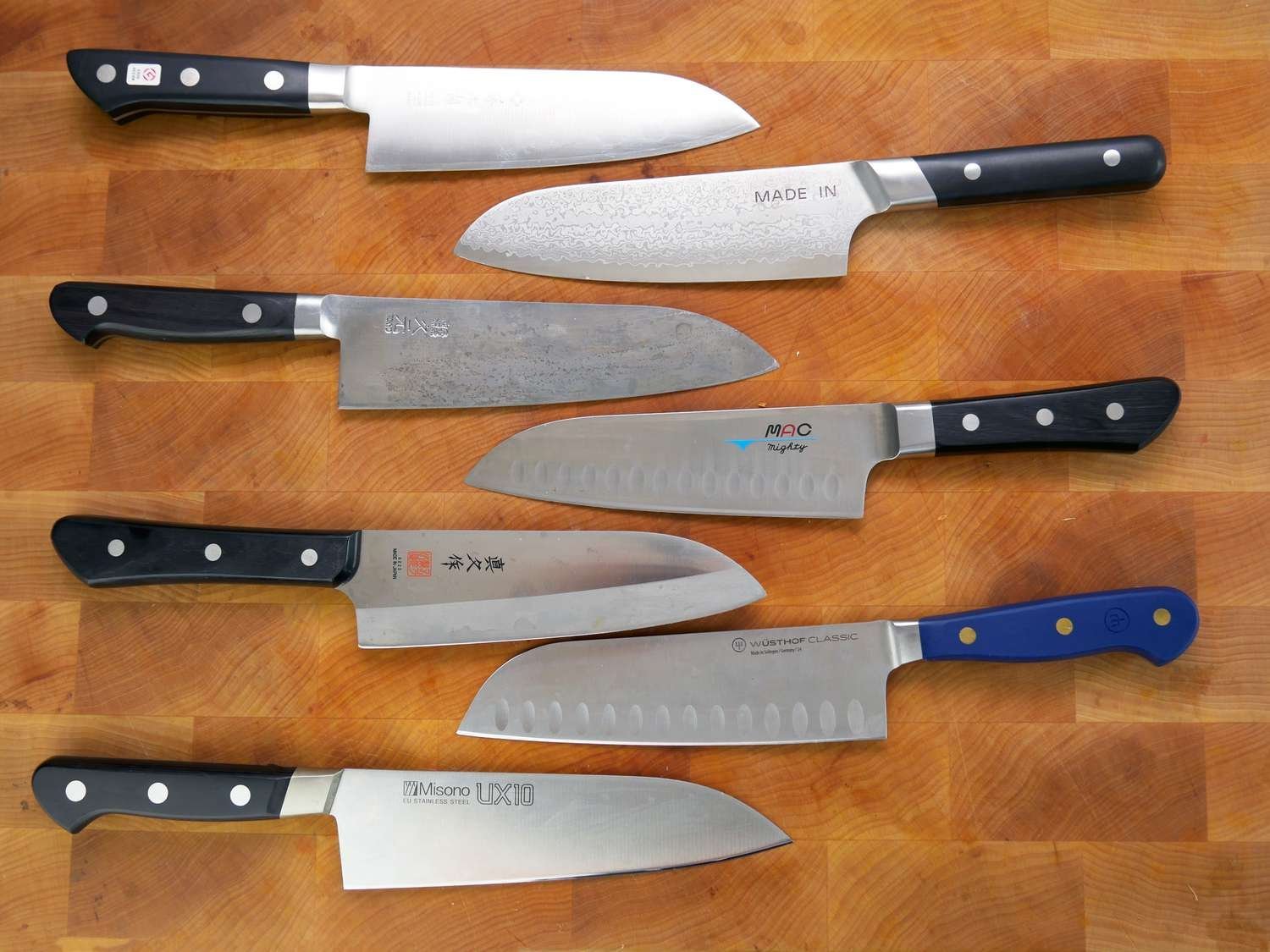
10 Best Santoku Knife
You’re standing at the cutting board, trying to slice onions and carrots for dinner. The heavy knife in your hand feels awkward, and wide potato rounds stick tight to the metal with every downward cut. You stop chopping because your wrist feels tired and your prep work is taking far too long. That frustration is usually what makes cooks look for the best santoku knife to take over daily prep.
Choosing the right tool is rarely simple because every design asks for a specific trade-off. You must balance the edge retention of hard Japanese steel against the forgiving durability of softer Western forgings, while weighing blade length against cutting board space. Some options feature hollow grooves to keep food moving, while others rely on a plain flat grind. This guide looks at the core details to help you choose the right blade for your kitchen.
1. Wüsthof Classic 7″ Santoku Knife

Right for: Cooks wanting classic German forged steel for daily kitchen prep.
This knife features a 7-inch high-carbon stainless steel blade cut with state-of-the-art technology. It’s forged from a single piece of steel with a full tang and full bolster, supported by a triple-riveted handle. Built in Solingen, Germany, it delivers a razor-sharp edge made for dicing vegetables and slicing meats wafer-thin.
Forged from a single piece of steel, the knife includes a full bolster and full tang designed to provide safety and stability while working. Hand washing is required to protect the metal and handle over years of cooking. DELETE
What works: – Single-piece forged construction gives stability. – Full tang with triple-riveted grip. – High-carbon steel offers easy maintenance. – Forged in Solingen, Germany.
Where it gives ground: – Full bolster limits heel sharpening. – Requires hand washing only.
Skip it if: you want a dishwasher-safe tool that handles quick cleanups without hand maintenance.
2. MAC Knife Professional series 6.5″ Santoku with dimples MSK-65

Right for: Busy home cooks seeking long-lasting sharpness from Japanese steel.
Made in Japan, this 6.5-inch knife uses sub-zero tempered steel designed to retain its edge better than standard steels. The razor-sharp edge features dimples ground along the blade face to ease slicing. Hand washing is recommended because the knife is explicitly not dishwasher safe.
The dimpled sides help wet ingredients slide off instead of stacking up, speeding through piles of vegetables on busy weeknights. However, the slightly shorter 6.5-inch cutting edge means you can’t easily divide massive heads of cabbage in one single stroke. It isn’t built for someone who wants heavy German bolsters or thick spine weight behind their cuts.
What works: – Sub-zero tempered steel edge retention. – Dimples reduce food sticking down. – Compact 6.5-inch Japanese design profile. – Razor-sharp cutting edge straight away.
Where it gives ground: – Strictly not dishwasher safe. – Shorter reach on larger produce.
Skip it if: you prefer heavy German heft and a thick metal bolster under your fingers.
3. Shun Classic 7″ Hollow Ground Santoku Knife

Right for: Precision slicers who want layered Japanese Damascus steel performance.
This handcrafted Japanese knife pairs a VG-MAX cutting core with 68 layers of Damascus cladding ground to a 16-degree edge. Its 7-inch hollow-ground blade creates air pockets to reduce friction while cutting vegetables, fruits, and proteins. The handle uses Pakkawood shaped into a D-profile, backed by free sharpening and honing.
The hollow indentations let you slice thin vegetables rapidly without pausing to wipe the blade face clean. But the very sharp 16-degree edge demands extra care, as hard bones or rough handling can damage thin Japanese edges. This knife isn’t made for anyone looking to chop through frozen foods or hard squash shells.
What works: – VG-MAX core with 68 Damascus layers. – Free factory sharpening and honing support. – Hollow ground indentations reduce friction. – D-shaped Pakkawood handle offers control.
Where it gives ground: – Fine 16-degree edge needs careful handling. – D-shape favors specific hand placements.
Skip it if: you chop rough bone or frozen foods that risk damaging fine edges.
4. Tojiro Knife Professional Santoku 6.7″ (17cm)

Right for: Left and right-handed cooks wanting simple Japanese steel.
The Tojiro Professional features a 6.7-inch (17cm) stain-resistant slicing blade made from cobalt alloy steel and 13-chrome stainless steel. Its base uses 18-8 stainless steel, paired with a black laminated reinforced ECO wood handle. It features an even double-bevel edge that works equally well for left or right-handed kitchen users.
The balanced cobalt alloy core keeps an even edge across hundreds of vegetables, providing smooth utility throughout prep work. However, the blade lacks side indentations, so moist potato slices or cucumbers may stick to the smooth metal surface while slicing. It isn’t meant for cooks who want hollow ground pockets to speed through starchy foods.
What works: – Cobalt alloy steel cutting core. – Even edge suits both hands. – Reinforced ECO wood handle build. – Stain-resistant stainless steel cladding layers.
Where it gives ground: – Flat sides let moist slices cling.
Skip it if: you need hollow ground dimples to stop moist vegetable slices from sticking.
5. WÜSTHOF Classic IKON 7″ Hollow Edge Santoku Knife

Right for: Cooks wanting German steel balance with an acute edge.
Forged from a single block of high-carbon stainless steel tempered to 58 HRC, this 7-inch knife features a distinct double bolster design. Its blade is ground to a narrow 10-degree cutting edge using Precision Edge Technology (PEtec) for high sharpness. The hollow edge uses vertical indentations to build air pockets, finished with a sleek contoured black handle.
The double bolster shifts physical balance toward the hand, making long dicing sessions feel controlled and steady. Still, the narrow 10-degree edge requires gentler slicing techniques than typical wide-beveled German kitchen knives. It isn’t the right choice for cooks wanting a flat, wide traditional Western chef profile.
What works: – Double bolster provides balanced handling. – Tempered to 58-degree HRC steel. – 10-degree edge angle slices cleanly. – Hollow indentations create air pockets.
Where it gives ground: – Acute edge needs gentle use.
Skip it if: you prefer heavy traditional cleaver-like durability over a sharp 10-degree edge profile.
6. Victorinox Swiss Classic 7 Inch Santoku knife

Right for: Anyone wanting a lightweight, dishwasher-safe utility prep knife.
This Swiss-made knife features a full-length stainless steel blade with a fluted Granton edge to limit sticking. It includes an ergonomic black handle shaped for lasting comfort, built into a lightweight frame. Unlike most specialized cutlery, the entire knife is fully dishwasher safe for fast everyday cleanup.
The lightweight build prevents wrist fatigue during lengthy potato peeling or onion dicing tasks. Because the knife has a lightweight design, it lacks the downward gravity that assists cuts through dense winter squash. It won’t suit cooks who want heavy metal bolsters and rigid heft.
What works: – Dishwasher safe for cleaning. – Fluted edge prevents food sticking. – Very lightweight build reduces fatigue. – Ergonomic handle provides secure comfort.
Where it gives ground: – Lacks heft for dense cutting.
Skip it if: you want heavy forged steel that uses its own weight to cut.
7. Mercer Culinary M20707 Genesis 7-Inch Santoku Knife

Right for: Cooks working in damp environments wanting non-slip handles.
Precision-forged from high-carbon German steel, this mid-sized chef’s knife uses a taper-ground edge for long-lasting sharpness and cutting efficiency. Its ergonomic handle is designed specifically to maintain a non-slip grip even when your hands are completely wet. It handles dicing onions, mincing shallots, and shredding cabbage, requiring hand washing with mild soap.
The textured handle grip prevents slips when handling wet vegetables or washing ingredients at the sink. Even so, the blade features completely smooth sides without hollow indentations, so dense vegetable pieces can cling to the face. It isn’t designed for cooks who want Granton dimples for automatic food release.
What works: – Precision-forged high-carbon German steel construction. – Non-slip handle holds when wet. – Taper-ground edge offers lasting efficiency. – Built for chopping, mincing, cutting.
Where it gives ground: – Flat sides offer no dimples. – Can’t go in the dishwasher.
Skip it if: you want dimpled blade faces that keep thin slices from clinging.
8. KYOKU Shogun Santoku

Right for: Cooks wanting extreme out-of-the-box sharpness with Japanese steel.
This knife features a 7-inch forged Damascus blade built around a VG-10 steel core hardened to 58-60 HRC. The edge is finished to a razor-sharp 8-12 degrees per side using the traditional 3-step Honbazuke method and nitrogen cooling. It includes an extra-wide blade profile, a military-grade G10 handle, a protective sheath, and a lifetime warranty against defects.
The extra-wide blade leaves plenty of knuckle clearance over the cutting board and acts as a scoop for chopped food. However, the ultra-thin 8-12 degree edge angle means accidental twisting against a hard board can result in edge roll. It won’t suit someone who wants a forgiving, thick utility bevel.
What works: – VG-10 core hardened 58-60 HRC. – Handcrafted 8-12 degree mirror edge. – Moisture and heat-resistant G10 handle. – Includes protective sheath and case.
Where it gives ground: – Thin edge angle requires discipline.
Skip it if: you cut with twisting motions that could damage an acute edge.
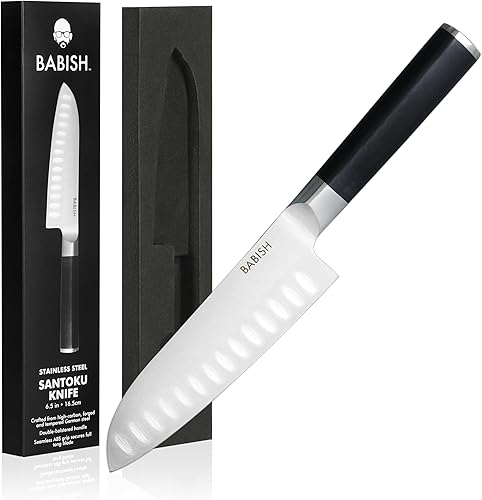
9. Babish 6.5 Inch Santoku Knife High Carbon 1.4116 German Steel
Right for: Everyday meal preparers looking for a compact forged blade.
Forged from a single piece of high-carbon 1.4116 German steel, this 6.5-inch santoku features a full-tang handle for a balanced grip. The blade is tempered, ground, and polished, then fitted with a Granton edge to reduce drag while dicing. It handles all basic food types, including meat, fish, and firm vegetables.
Its compact profile feels nimble on small wooden boards, making fast work of garlic and individual garnishes. Because it uses a slightly shorter reach, processing large melons or wide heads of lettuce requires multiple passes. It isn’t built for someone who needs a broad, full-sized slicing blade.
What works: – Forged single-piece German steel construction. – Granton edge reduces slicing drag. – Full-tang handle provides balanced control. – Polished blade cuts all foods.
Where it gives ground: – A moderately shorter blade limits broad tasks.
Skip it if: you prep large heads of cabbage that need a longer cutting edge.
10. OXO Good Grips 5 in Santoku Knife with Locking Sheath

Right for: Campers, travelers, or cooks with very small kitchens.
Featuring a 5-inch stainless steel blade with a rounded tip, this compact tool delivers consistent chopping and mincing in tight spaces. It comes with a locking sheath that covers the straight edge for safe transport inside drawers or travel bags. The handle uses soft, non-slip material designed to stay secure in the hand even when wet.
The included locking sheath makes it safe to throw the knife into a picnic tote or camping kit without danger. However, the short 5-inch blade can’t handle broad meal prep or large roasts on regular cutting boards. It isn’t right for someone preparing large family dinners every evening.
What works: – Locking sheath secures the blade. – Non-slip handle works when wet. – Compact 5-inch blade fits anywhere. – Rounded tip avoids accidental punctures.
Where it gives ground: – 5-inch blade limits cutting capacity.
Skip it if: you need to prep big family meals that require long slicing strokes.
Also Worth Considering
The Mercer Culinary M23590 Renaissance offers a full-sized santoku design for cooks wanting an alternative model. The Mercer Culinary M22707 Millennia Black features a standard-length Granton edge santoku blade with a black handle. The WÜSTHOF Hollow Edge Santoku Knife brings Solingen steel quality down to a light 5-inch footprint, providing a hollow edge for cooks who want German metal in a small utility size.
How to Think Before You Choose
Steel Hardness Versus Edge Toughness
Hard Japanese steels like VG-10 hold a sharp edge through months of slicing vegetables, but the rigid metal can chip if it hits bone. Softer German high-carbon stainless steels absorb accidental knocks and board impacts without chipping, though they need more frequent alignment with a honing rod. Anyone chopping varied ingredients does best with standard German steel because it forgives accidental bone contact and cutting board slips. Check your main cutting surface before choosing; if you use hard bamboo, marble, or glass boards, hard Japanese steel risks premature micro-chipping.
Hollow Indentations Versus Plain Flat Blades
A hollow ground or Granton edge features small vertical dimples carved along the blade face that trap small pockets of air. These pockets prevent moist, dense vegetables like potatoes, zucchini, and cucumbers from creating vacuum suction against the blade. Flat-ground blades lack these air pockets, meaning you’ll occasionally stop to peel stuck food off the metal face. Most cooks should choose a hollow edge to keep food moving smoothly across the board. Look at what you slice most often; if you cut starchy tubers daily, dimples save prep time.
Handle Materials and Kitchen Moisture
Handles range from traditional woods and engineered Pakkawood to molded plastics and non-slip rubberized materials. Wood provides warmth and classic balance, but it absorbs standing moisture if left soaked near the sink. Synthetic materials and resin-treated G10 resist water damage and require no conditioning oil. For raw meat prep and quick kitchen cleanup, non-porous handles wash clean easily. Check how often items sit damp by your sink before buying bare wood.
Who Should Skip These Altogether
- Cooks who rely exclusively on a rocking-motion cut across the board, who would be served better by a curved Western chef’s knife.
- People who already own a sharp eight-inch chef’s knife that handles their daily mincing, slicing, and dicing without wrist fatigue.
- Kitchens that frequently cleave through thick beef bones, frozen foods, or hard squash shells, which require a heavy meat cleaver.
- Anyone who will only wash kitchen tools in high-heat dishwashers, where fine wooden handles and high-carbon cutlery warp and degrade.
If you want balanced German steel for daily family meals, choose the Wüsthof Classic Santoku, while the KYOKU Shogun Santoku suits anyone demanding Japanese steel precision. Check the material of your cutting board today to make sure your choice matches your surface.
Frequently Asked Questions
Can I sharpen these knives on ordinary pull-through sharpeners?
Most pull-through sharpeners use fixed wide angles made for thick Western edges. Running an acute Japanese santoku through coarse carbide slots will strip metal and ruin the fine edge. You should use a double-sided whetstone or an angle-guided sharpening system matched to the blade’s specific angle.
What kind of cutting board should I use with these blades?
Use end-grain wood, edge-grain hardwood, or soft food-grade rubber cutting boards. Hard surfaces like granite, ceramic, stone, and tempered glass will instantly dull or chip fine steel edges. Soft wooden boards cushion the downward force of your chopping and preserve edge sharpness.
Why do some santoku blades have small dimples on the sides?
Those dimples are hollow ground indentations that create small air pockets between the steel and the ingredient. When you slice wet or starchy foods like potatoes and cucumbers, the air pockets break the surface vacuum. This prevents food slices from sticking to the knife face.
Is a five-inch santoku knife enough for everyday dinner cooking?
A five-inch santoku works well for mincing garlic, chopping small herbs, and slicing individual apples. However, it lacks the blade length needed to cut through large cabbages, whole onions, or thick meat roasts in one smooth pass. An ordinary dinner cook usually needs a mid-sized blade to tackle everyday prep.
How should I clean and dry my knife after meal prep?
Wash the blade immediately after use using warm water, mild dish soap, and a non-abrasive sponge. Dry it completely with a clean towel before placing it into a wooden block, magnetic strip, or protective blade sheath. Never leave carbon or stainless cutlery soaking in standing water.




One Comment