What Is the Difference Between an Upright and Recumbent Exercise Bike
If you've ever wondered what is the difference between an upright and recumbent exercise bike, you're in good company. It's usually the first question people ask when shopping for home cardio. The honest answer is that these are two machines built for two different riders, and neither one wins across the board.
Here's what our research shows. An upright bike keeps your torso vertical with your feet below your hips, like a road bike. A recumbent bike reclines you into a seat with a backrest while your feet reach forward.
That one geometry change affects your back, your comfort, and your calorie burn. As of 2026, typical recumbents support 300 to 400 pounds, while most home uprights cap out around 250 to 300 pounds.
Quick Answer
The upright bike keeps your torso vertical, with feet below your hips. The recumbent reclines you into a seat with a backrest, feet reaching forward. Uprights feel closer to an outdoor bike and encourage a more intense position.
Recumbents are kinder to your lower back and feel more relaxed overall.
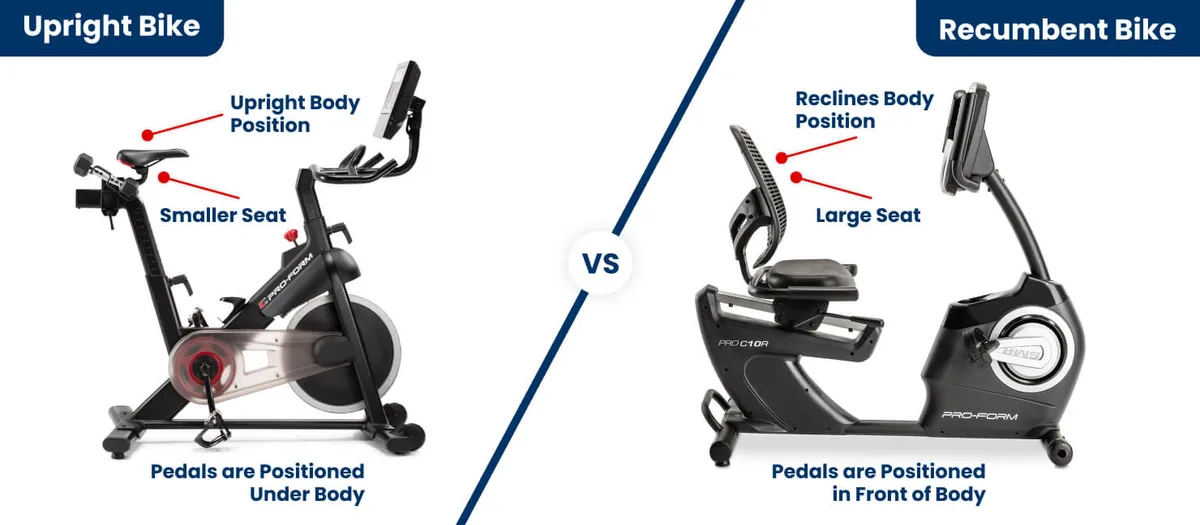
Image source: Bing (Web (fair-use with source credit))
What Actually Matters in This Comparison
Most buyers miss the real difference. It isn't just about comfort. It's about how your body aligns over the pedals, and that alignment changes every single ride.
If you've compared cardio machines before, you know there's no universal winner. The same applies here. An upright won't automatically burn more calories.
A recumbent won't automatically be the "easy bike." What one rider calls a perfect seat, another calls a torture device.
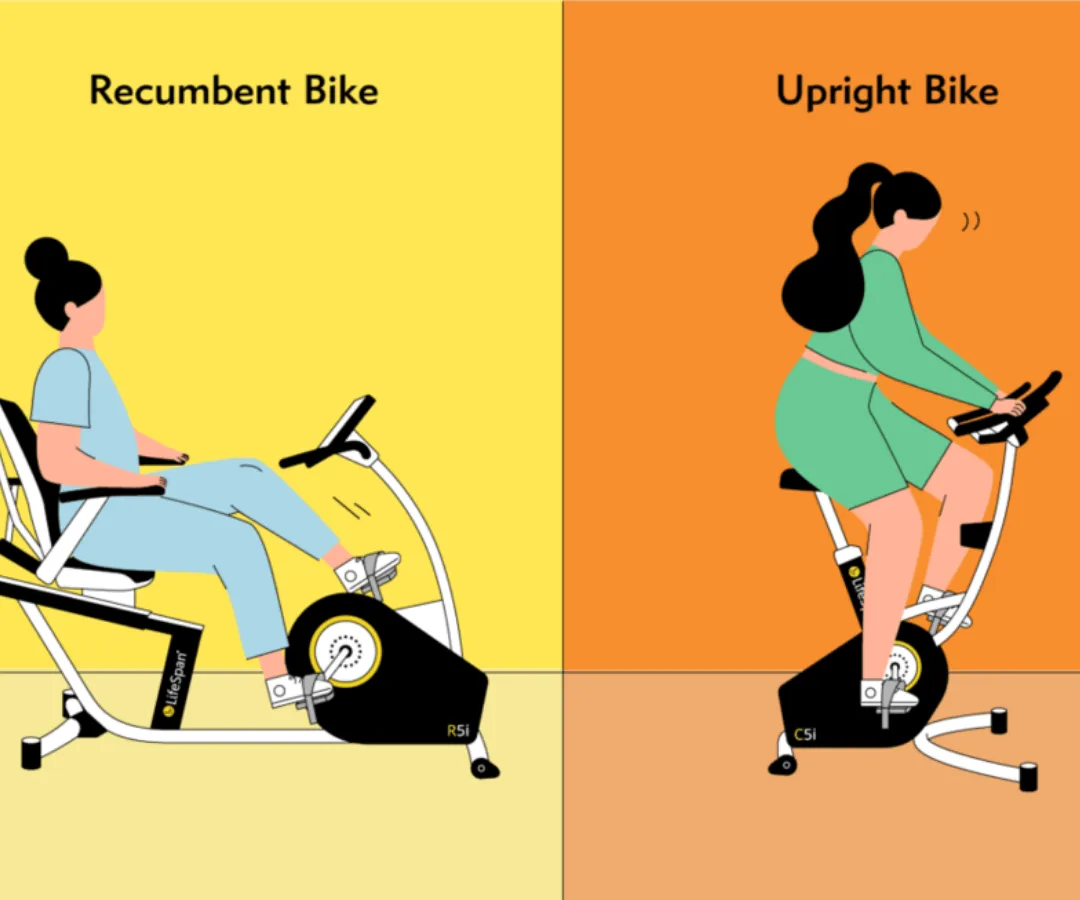
Image source: Bing (Web (fair-use with source credit))
Think of it this way. A recumbent is like a comfortable armchair that happens to move your legs. An upright is like a road bike bolted to your living room floor.
Neither is better until you know which body, injury history, and workout style you're shopping for. That's the real comparison.
If you're also deciding between a bike and a rower for the same space, the same rule applies. The best machine is the one you'll actually use. Our take on whether a rowing machine earns its spot in a home gym came to the same conclusion.
How They Work Differently (and How It Feels)
Both bikes give you a flywheel, a resistance system, and a display. But the riding position changes how everything feels. On an upright, you lean forward slightly, grip a handlebar set ahead of you, and pedal in a vertical circle.
On a recumbent, you sit back, grip handles at your sides, and push pedals that sit out in front.
| Feature | Upright bike | Recumbent bike |
|---|---|---|
| Posture | Leaning forward, torso near vertical | Reclined, back supported by a backrest |
| Foot position | Directly below your hips | Level with or slightly ahead of your hips |
| Hand position | Forward handlebars | Side handles or over-the-lap grips |
| Main muscle focus | Quads, hamstrings, plus core and stabilizers | Quads and glutes, less core demand |
| Seat style | Narrow bicycle saddle | Wide, chair-style seat with backrest |
The American Council on Exercise has noted that upright positions involve more upper-body engagement because you're supporting your own torso. That makes the workout feel more active, even when the calorie total is similar.
You can also stand on an upright bike to add force. On a recumbent, you can't, because your back stays pressed against the seat. That's why interval riders usually lean toward uprights.
The same air-versus-magnetic tradeoff shows up in rowers, where the resistance type completely changes how the machine feels under load.
The Real Difference: Your Back, Hips, and Comfort
Here's where the two bikes stop being similar. On an upright, your pelvis tilts forward and your spine sits in a flexed position. Some riders can hold that all day.
Others feel lower back pain within ten minutes. A recumbent keeps your pelvis more open and gives your lumbar spine a stable backrest to press against.
Does that mean a recumbent is always better for your back? Not for everyone. Some people find the wide seat puts extra pressure on their tailbone.
Others dislike that they can't shift their angle much. The goal is finding which spinal position feels neutral, not strained.
The recumbent's forward pedal position also creates a more open hip angle. That's a huge relief for riders who feel hip compression on an upright saddle. It also keeps your hands free, which reduces wrist and shoulder strain for people with arthritis or grip issues.
Aggregate owner reviews show recumbents are the most common recommendation for riders with sciatica or herniated discs. It's a pattern, not a prescription, but a strong one.
If your back pain extends to other machines, you might also wonder whether a rower is gentler. Our breakdown of back-friendly rowers covers that question in more detail.
Who Should Pick Which
This is the section that saves you money. Instead of choosing based on marketing photos, match the machine to your body and your routine.
| If you… | Upright tends to fit | Recumbent tends to fit |
|---|---|---|
| Have lower back pain | Sometimes, if posture is good | Usually, thanks to the backrest |
| Want a quick, intense burn | Yes | It works, but with less position variety |
| Have balance concerns | Less stable | Yes, low center of gravity |
| Are over 250 pounds | Check the weight limit | Most have higher limits |
| Get wrist numbness leaning forward | No | Yes, side handles are easier |
| Like reading or watching TV while riding | Possible | Much easier, thanks to the backrest |
For older adults, the National Institute on Aging recommends low-impact, moderate cardio to keep mobility strong as we age. Recumbents fit that recommendation well, since the reclined seat lowers the risk of falling sideways.
Tall riders should check seat post height on uprights. Heavier riders should check weight capacity before anything else. And anyone with limited floor space should measure twice, because recumbents run longer than most people expect.
The Bottom Line
Pick an upright if you want a fast, familiar, spine-forward cycling experience. Pick a recumbent if you want a relaxed, supported ride that's easier on your back and simpler to mount. Let your body, not a sales photo, make the call.
If you're already comfortable using a rower for full-body work, consider pairing either bike as a lower-body complement.
How to Test Each Type (Without Owning It)
Before you buy either, spend real time on both. Ten minutes, not thirty seconds. That's long enough to notice pressure points, wrist strain, or that odd "can't breathe" feeling some riders get in a reclined position.
Here's how to run a fair test:
- Find a gym with both. Most commercial gyms carry a few of each model.
- If you don't belong to a gym, ask a fitness equipment showroom. They normally let you sit on display units.
- Adjust the seat to your leg length before judging. A bike set up wrong will feel terrible.
- Pedal at a steady pace for ten to fifteen minutes. Watch your back, hips, and hands.
- Switch to the other bike and repeat with the same time and resistance.
On an upright, your hips should stay stable without rocking. Your shoulders should stay relaxed, and your wrists shouldn't take any weight. On a recumbent, your knee should have a slight bend at the end of the stroke, and your lower back should feel supported, not arched.
The same fitting principle applies to rowers. Adjusting the foot straps and seat before you start makes all the difference. Our guide to setting up a rower properly walks through that process step by step.
And before you fall in love with any option, measure your available floor space at home. Recumbents are long, and some uprights need extra clearance for getting on and off. Knowing your footprint early prevents most buyer's remorse.
You can gauge the size you have to work with the same way you would for a rowing machine.
Common Mistakes to Avoid
Buying for "Maximum Calories"
Many people pick based on which bike burns more. Research shows calorie burn at the same heart rate is nearly identical on both. The machine you'll actually use wins, not the one that looks harder.
Consistency beats intensity for long-term results.
Assuming Recumbent Means Lazy
The reclined position doesn't reduce muscle demand. Push hard and you'll feel your quads and glutes burn. Some riders even find it harder to push big resistance because you can't use your body weight to help.
It's a different workout, not an easier one.
Not Measuring the Floor
Recumbents run 45 to 55 inches long. That eats up a lot more room than most people expect. Meanwhile, some uprights need open space behind them so you can swing a leg over.
Measure both before you shop.
Ignoring Weight Capacity
Check the manufacturer spec before buying anything. Most recumbents handle 300 to 400 pounds. Many home uprights stop at 250 to 300.
Going over the limit voids warranties and makes the frame unstable.
Judging a Bike in 30 Seconds
The first half minute on a recumbent feels alien. Your legs reach forward, you can't see your feet, and it seems too relaxed. Give any bike ten minutes before you form an opinion.
The initial weirdness usually fades into comfort.
Frequently Asked Questions
Which bike burns more calories?
Neither, when you compare at the same effort. Calorie burn tracks with heart rate and resistance, not frame style. An upright might feel harder because you're supporting your torso, but the number on the display stays similar.
Pick the bike you'll ride consistently.
Is a recumbent bike good for weight loss?
Yes. Weight loss comes from sustained cardio and a calorie deficit, not from standing up while you pedal. A recumbent lets you push serious resistance with less joint stress, which means longer rides.
Longer workouts at a moderate pace add up quickly.
Is a recumbent bike better for a bad back?
Often, but not always. The backrest supports your lumbar spine and keeps your pelvis open, which relieves pressure on the lower back. That said, some riders find the wide seat aggravates tailbone pain.
Try both and see which spinal position feels neutral.
Can you get a good workout on a recumbent bike?
Absolutely. Interval training, hill climbs, and sustained endurance rides all work on a recumbent. You lose the ability to stand, but you gain stability and comfort.
Many riders hit higher average wattage because they can tolerate longer sessions without back or wrist pain.
Which bike is easier on your knees?
Both are low-impact, so neither pounds your joints. The recumbent's forward pedal position can feel easier if you have restricted hip mobility or knee compression on an upright. Just make sure the seat is positioned so your knee stays slightly bent at full extension.


One Comment