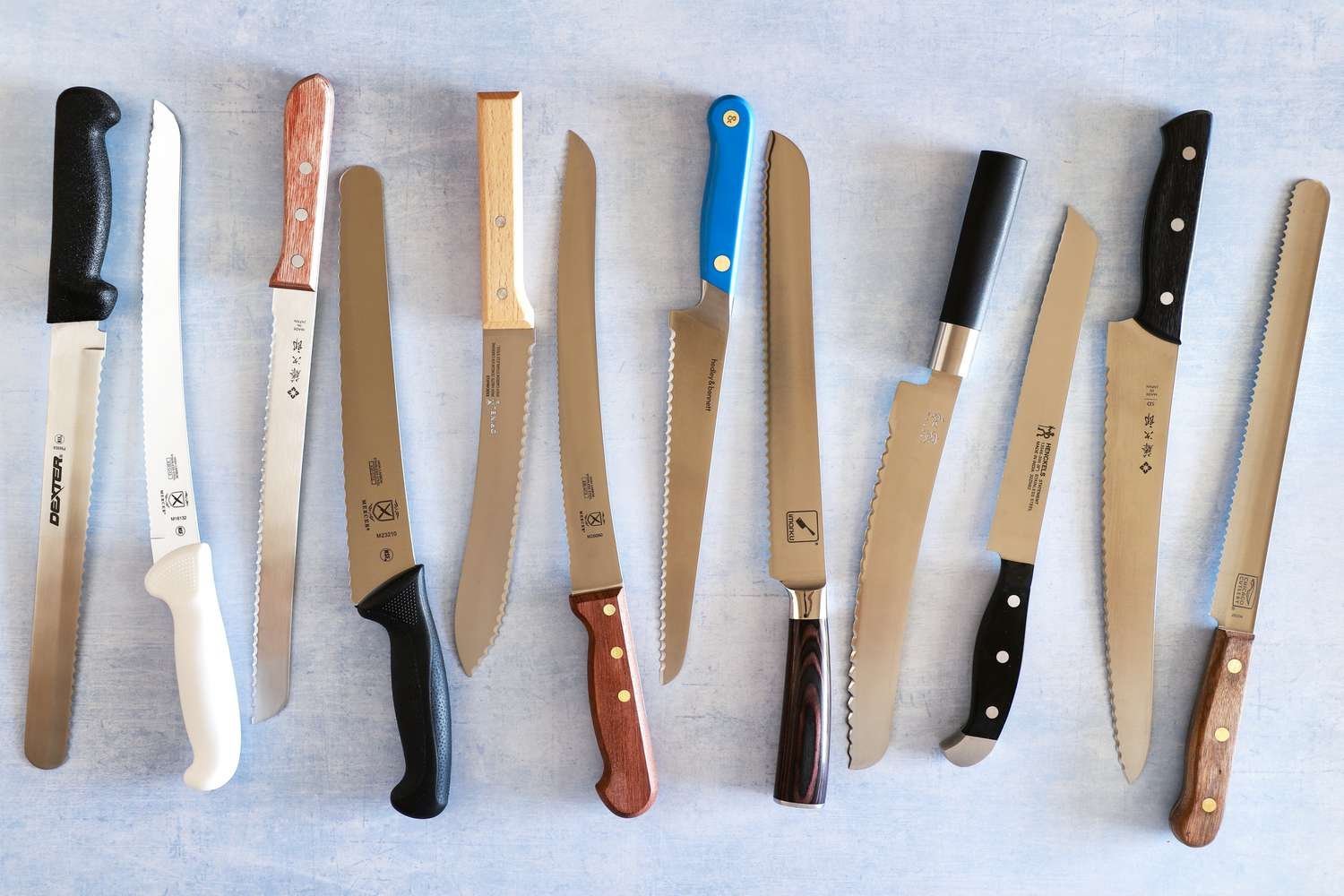
10 Best Bread Knife
Finding the best bread knife comes down to how you cut your loaves every morning. A smooth blade tears soft crumb, but the wrong serrated tool will crush a crusty loaf into flat dough. The tools here look similar at first glance, but they differ in blade length, steel hardness, and handle balance. These small details show up fast once you start slicing through firm sourdough or soft sandwich bread. Every pick below is judged on the same three things — what it’s strong at, what it gives up, and what living with it would ask of them.
1. Victorinox Fibrox 10.25 Inch Bread Knife

Best for: bakers who need an easy-to-clean commercial workhorse daily
This knife features a long 10.25-inch blade stamped from cold-rolled, high-carbon stainless steel that’s ice-tempered for edge retention. The manufacturer highlights its patented Fibrox handle, which uses thermoplastic elastomers to keep a non-slip grip even when wet. It also carries a conical ground edge and an NSF approval seal for food sanitation standards.
Strengths: – Long 10.25-inch blade handles wide crusty loaves easily – Non-slip Fibrox handle provides a safe, comfortable grip – Dishwasher safe design allows for very quick cleanup – Stamped cold-rolled steel creates a lightweight tool – NSF approved build meets commercial food sanitation standards
Trade-offs: – Large 26-centimeter blade takes up lots of drawer space – Stamped steel blade lacks a forged balance bolster
Living with this tool means you won’t have to worry about damp hands slipping off the handle while slicing wet bread. You can put it directly into the dishwasher after cutting sticky pastry or sourdough, though hand drying keeps it ready. The bolsterless edge lets you use the full length of the blade, which makes future sharpening sessions straightforward across the entire cutting surface.
| Best for | Why |
|---|---|
| High-volume kitchens | Dishwasher safe and NSF certified build |
| Wide artisan loaves | Extra-long 10.25-inch cutting edge |
| Wet food prep | Non-slip textured thermoplastic elastomer handle |
2. Wüsthof Classic Ikon 9″ Double-Serrated Bread Knife

Best for: cooks seeking a heavy German forged knife with balance
This knife centers its design on a precision-forged 9-inch blade made from a single block of high-carbon stainless steel. It’s tempered to 58 HRC and sharpened with Precision Edge Technology for double the edge retention of older versions. The Solingen-made tool features a sleek black handle equipped with a double bolster for balance and control.
Strengths: – Precision forged from high-carbon German stainless steel – Tempered to 58 HRC for long-lasting edge retention – Double bolster design provides exceptional cutting balance – Precision Edge Technology yields a razor-sharp profile – Backed by a limited lifetime manufacturer warranty
Trade-offs: – Double bolster design adds weight during long slicing sessions
Owning this knife asks you to take care of fine German cutlery rather than tossing it into a crowded sink. The solid build means you’ll stop worrying about blade flex when tackling heavy, dense crusts week after week.
| Best for | Why |
|---|---|
| Tough crusty boules | Rigid 58 HRC forged steel blade |
| Balanced kitchen handling | Double bolster distributes weight evenly |
| Long-term durability | Solingen construction with lifetime warranty |
3. Global G-9 Bread Knife

Best for: people who prefer seamless all-metal construction and light balance
This knife is built around an 8.75-inch blade crafted from high-tech molybdenum/vanadium stainless steel. Global emphasizes a lightweight, precisely balanced build with a razor-sharp cutting edge that resists dulling. Its stainless-steel handle is molded directly to the blade and features dimples for a secure grip.
Strengths: – High-tech molybdenum and vanadium steel edge stays sharp – Seamless all-metal construction leaves no seams for grime – Lightweight balance reduces fatigue over repeated cuts – Textured dimples provide a secure, slip-resistant handhold – Covered by a lifetime guarantee against defect damage
Trade-offs: – Smooth metal handle feels hard during heavy downward force
Using this knife day to day means you’ll appreciate the seamless design because food crumbs never get trapped in handle rivets. Because it doesn’t carry extra bolster weight, your wrist won’t tire out when you prep multiple loaves for dinner.
| Best for | Why |
|---|---|
| Small kitchen prep | Balanced and lightweight 8.75-inch design |
| Sanitary maintenance | Seamless one-piece stainless steel construction |
| Modern kitchens | Sleek dimpled metal aesthetic profile |
4. ZWILLING Twin Signature 8-inch Bread Knife

Best for: users who want German steel with an ergonomic grip
This 8-inch bread knife is stamped from special-formula German stainless steel and ice-hardened using the FRIODUR process for resilience. It features a 57 Rockwell hardness rating with a 15-degree edge per side to keep it sharp with minimal care. The polymer handle is permanently bonded to a full tang blade that runs straight through the handle for balance. It isn’t for bakers who regularly slice giant bakery boules that need a 10-inch blade.
Strengths: – Ice-hardened FRIODUR blade offers superior edge resilience – Hardened to 57 Rockwell for long cutting life – Full tang polymer handle delivers solid balance and force – 15-degree edge angle ensures clean, razor-sharp cuts – Stamped German steel construction is labeled dishwasher safe
Trade-offs: – Compact 8-inch blade struggles across very wide loaves – Stamped steel lacks the heavy heft of forged models
Having this knife around your kitchen lets you cut soft sandwich loaves and crusty baguettes without flattening the tender crumb. While the listing notes it’s dishwasher safe, rinsing it under warm water right after use protects the edge angle. You’ll stop fussing over loose handle scales because the ergonomic polymer grip is bonded directly to the full tang.
| Best for | Why |
|---|---|
| Standard sandwich loaves | Compact 8-inch blade allows quick control |
| Low maintenance care | Dishwasher safe special formula steel build |
| Firm downward leverage | Full tang runs through entire polymer handle |
5. Shun Classic 9″ Bread Knife

Best for: cooks wanting handcrafted Japanese Damascus steel precision
This 9-inch bread knife features wide serrated teeth designed to cut through hard crusts without tearing soft interiors. It uses a core of VG-MAX steel supported by 68 layers of Damascus cladding, sharpened to a precise 16-degree cutting edge. The handle is made from durable Pakkawood in a traditional D-shape that works for both left and right hands.
Strengths: – Core VG-MAX steel holds an extremely sharp edge – 68 Damascus cladding layers provide resilience and style – Wide-set serrated teeth slice cleanly without crushing bread – D-shaped Pakkawood handle fits both hands securely – Handcrafted in Japan and backed by free honing services
Trade-offs:
Living with this Japanese knife means you’ll treat it with the care that fine layered cutlery deserves. The wide tooth profile prevents squashing fresh bread, so you can stop wrestling with soft brioche or hard sourdough crusts.
| Best for | Why |
|---|---|
| Delicate soft breads | Wide teeth prevent tearing tender dough crumb |
| Japanese knife fans | VG-MAX core with 68 Damascus layers |
| Long-term service | Handcrafted build supported by free factory honing |
6. Mercer Culinary M23210 Millennia Black Handle
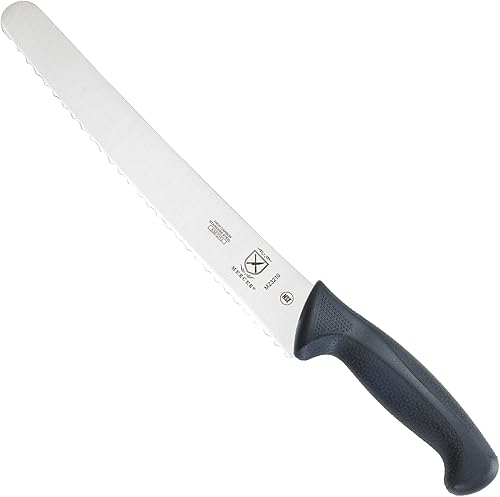
Best for: everyday cooks who prioritize non-slip safety and wavy edges
This knife pairs a 10-inch wavy edge blade made from Japanese high-carbon steel with a durable ergonomic handle. The handle features textured finger points to provide a non-slip grip during kitchen prep. It’s engineered with a balance tang to slice smoothly through bread, angel food cake, tomatoes, and meatloaf. It isn’t for buyers who want dishwasher-safe cutlery, as the manufacturer explicitly forbids machine washing.
Strengths: – Extended wavy edge cuts bread, cakes, and tomatoes – Japanese high-carbon steel allows easy edge maintenance – Textured finger points offer exceptional slip resistance and safety – Tang construction delivers steady leverage across wide foods – Soft crumb remains intact without tearing or shredding
Trade-offs: – Explicitly barred from dishwashers and long soaking – Generous blade length demands large storage blocks
Living with this tool means taking two minutes to hand-wash and towel-dry it after every single meal prep. Because the listing specifically warns against machine cycles or soaking, keeping a cloth nearby becomes part of your routine. In return, you stop worrying about your fingers sliding forward onto the wavy blade when your hands get greasy.
| Best for | Why |
|---|---|
| Multi-food prep | Wavy edge cuts loaves, soft cakes, tomatoes |
| Slippery kitchen tasks | Ergonomic grip with raised textured finger points |
| Large baked goods | Extended 10-inch blade covers big cutting boards |
7. Cutluxe Serrated Bread Knife
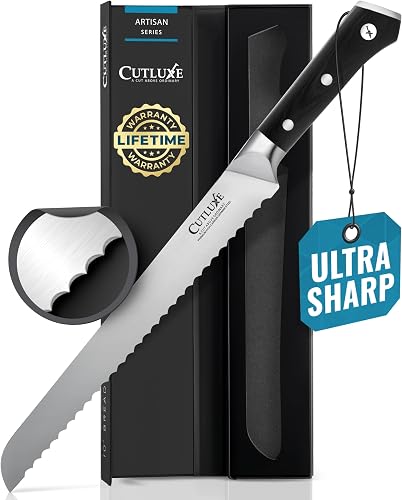
Best for: bakers slicing dense artisan sourdough with a heavy blade
This knife uses high-carbon German steel forged to a 56+ Rockwell hardness and hand-sharpened to a 14-16 degree edge per side. Its 10-inch serrated edge is tapered to handle dense sourdough, bagels, and crusty baguettes with minimal crumb mess. The handle features luxury pakkawood triple-riveted over a full tang to create a stable, sanitary tool for home kitchens.
Strengths: – Forged German steel rated at 56+ Rockwell hardness – Hand-sharpened 14-16 degree edge minimizes loose crumbs – Triple-riveted pakkawood handle offers strong structural stability – Full tang build provides balance for dense sourdough cutting – Backed by a full lifetime warranty against material defects
Trade-offs: – Heavy forged long steel blade feels unwieldy for quick buns
This knife will become your dedicated board tool for crusty country boules that break weaker, lighter blades. You’ll keep the triple-riveted pakkawood conditioned by hand washing it and never leaving it soaked in the sink. The hand-finished edge cuts cleanly on the pull stroke, meaning you won’t have to sweep piles of stray crumbs off your counter.
| Best for | Why |
|---|---|
| Tough sourdough loaves | Heavy forged German steel cuts firm crusts |
| Crumb-free slicing | Tight 14-16 degree hand-sharpened edge angle |
| Traditional styling | Triple-riveted laminated pakkawood full-tang handle |
8. HENCKELS Statement 8-Inch Bread Knife

Best for: small households needing a compact, dishwasher-safe daily slicer
This lightweight 8-inch bread knife uses a single-piece, precision-stamped stainless steel blade with a satin finish. It features a finely honed serrated edge that handles everything from sandwich brioche and pita bread to soft pastries and large fruit. The manufacturer emphasizes easy care, noting the blade resists rust and stains even when cleaned in the dishwasher. It isn’t designed for large-scale artisan bakers who need extra reach to split wide boules.
Strengths: – Compact blade stores easily in standard knife blocks – Lightweight single-piece construction prevents wrist strain – Finely honed serrations tackle brioche, pita, and produce – Stamped German-engineered steel resists rust and stains
Trade-offs: – Shorter length can struggle through wide artisanal bread rounds – Stamped design lacks the cutting authority of forged steel
Living with this knife means you won’t have to baby it after slicing a simple morning bagel or a warm pita pocket. You can put it right into the dishwasher without fretting over rust or loose wooden rivets. Its lightweight body makes it easy to grab for quick fruit cutting, though you’ll notice the shorter blade if you tackle wide homemade sourdough.
| Best for | Why |
|---|---|
| Quick breakfast prep | Compact 8-inch blade cuts bagels and pitas |
| Hectic weeknights | Rust-free steel rated safe for dishwasher use |
| Small kitchen storage | Lightweight stamped profile fits shallow drawers |
9. Tojiro Bread Knife
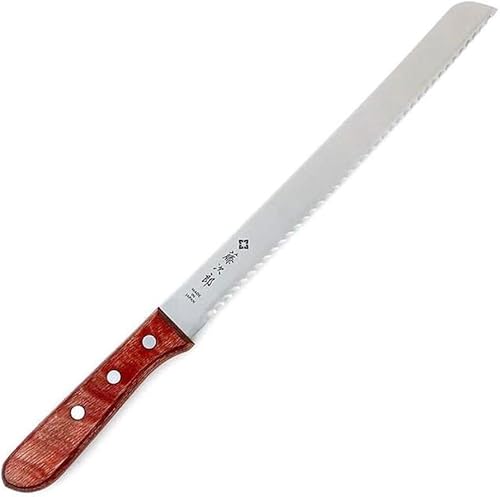
Best for: bakers who need an extra-long Japanese slicing edge
This knife features a 14.75-inch overall footprint made with Japanese hand craftsmanship and a reinforced laminated wood handle. It utilizes stainless steel paired with a wooden grip to provide an extended reach for slicing wide bakery items. It’s definitely not for cooks working in small kitchens with tight counter spaces and shallow knife blocks.
Strengths: – Extra-long 14.75-inch profile covers exceptionally wide baked items – Hand-made Japanese craftsmanship provides traditional blade styling – Reinforced laminated wood handle offers durable wooden grip – Stainless steel edge resists kitchen corrosion during daily slicing
Trade-offs: – Extremely long footprint is hard to store in common blocks
Living with this oversized tool asks you to clear ample space on your kitchen cutting board before you begin slicing. The unusual length means you can cut completely across large loaves without snagging the blade tips, provided you have room to store it.
| Best for | Why |
|---|---|
| Oversized artisan loaves | Extra-long 14.75-inch reach clears large baked goods |
| Japanese cutlery fans | Traditional hand-made Japanese steel design |
| Wooden handle setups | Reinforced laminated wood handle construction |
10. SYOKAMI 2026 Upgrade Bread Knife

Best for: right-handed bakers who want uniform slice thickness from guides
This specialty bow-style cutter mounts a 420J2 surgical stainless steel blade into a food-grade stainless steel frame. The blade drops 0.5mm below the frame and connects to an offset handle, ensuring your knuckles clear the board while finishing cuts. It features four built-in frame markings at 1/4, 1/2, 3/4, and 1-inch intervals to guide slice thickness cleanly. It isn’t built for left-handed bakers, as the listing states it’s optimized solely for right-handed use.
Strengths: – Four guide markings create consistent slice thicknesses up to 1-inch – 420J2 surgical stainless steel slices crusts without crushing crumb – Offset handle provides full knuckle clearance down to the cutting board – Serrations match standard household sharpening rods for easy upkeep – Includes a protective wall-mountable cover for safe kitchen storage
Trade-offs: – Design is explicitly optimized only for right-handed users – Tensioned blade screws must not be removed by the owner
Living with this bow cutter changes your morning bread routine by eliminating uneven, wedge-shaped slices of toast. You’ll use the frame markings to measure exact portions, and the offset handle keeps your hand from banging the board. Keeping it sharp is easy since the serration profile accepts regular household sharpening rods, and the hanging cover keeps it safe on the wall.
| Best for | Why |
|---|---|
| Uniform sandwich slices | Frame markings guide 1/4 to 1-inch thickness |
| Knuckle protection | Offset handle drops blade 0.5mm below frame |
| Easy edge maintenance | Serrations fit standard household sharpening rods |
Also Worth Considering
The Wüsthof Gourmet 8″ Bread Knife provides an 8-inch black-handled option for cooks wanting a shorter blade. The SHAN Inch Japanese Bread Knife features an 8-inch blade built from 9-layer 10Cr15MoV high-carbon steel for buyers focused on layered metalwork. Finally, the Bloomhouse Bread Knife offers an 8-inch German stainless steel full-tang serrated blade finished with a forged Italian olive wood handle.
Side by Side
The table below compares the key blade lengths, construction styles, and handle materials across all ten bread knives.
How to Judge One of These
Blade Length and Clearance
A bread knife needs enough length to saw across a loaf without pulling the tip inside the crust. Shorter 8-inch blades work great on narrow baguettes, bagels, and small sandwich loaves, and they easily tuck inside compact kitchen drawers. Longer 10-inch blades let you slice wide sourdough boules in smooth, single strokes without tearing the tender crumb. You can check your wooden cutting board at home to see if a longer blade has enough working room.
Serration Shape and Pitch
Deep pointed serrations bite aggressively into hard, crackly crusts, but they tear up very soft white bread. Wavy scalloped teeth slide gently through delicate pastries, angel food cakes, and ripe tomatoes without ripping the skins. Some blades use wide tooth spacing to prevent loose crumbs from scattering across your counter during breakfast prep. Looking closely at the tooth profile in product photos will show you whether it points sharply or curves smoothly.
Steel Hardness and Care Needs
Harder steel around 58 HRC stays sharp through months of tough crusts, but it requires careful washing and dedicated hand drying. Stamped blades with lower hardness ratings are more forgiving, often carrying dishwasher-safe ratings that save cleanup time in busy family homes. When checking sanitation standards, look for trusted marks like an NSF food equipment certification to ensure the handle and blade materials resist bacteria buildup. Make sure to confirm the handle material before purchase so you know if it can handle water or needs gentle hand care.
Damascus Cladding Hype
Many premium Japanese knives advertise dozens of folded Damascus steel layers wrapped around the central cutting core. While these rippled patterns look striking on a kitchen rack, the decorative cladding doesn’t make the knife cut crusty bread fast. The only part cutting your loaf is the exposed core edge along the serration tips. Check the core steel type on the package rather than paying attention to how many outer visual layers surround it.
The Victorinox Fibrox Bread Knife suits the most common daily kitchen needs with its balanced non-slip grip and dishwasher-safe build, while the Syokami Bow Bread Knife fits the unusual need of bakers wanting guided thickness without hand guesswork. Measure the width of your favorite weekly loaves to see which blade length fits your board best.
Related guides
Frequently Asked Questions
Can I clean my bread knife inside a home dishwasher?
You can only wash it in a dishwasher if the manufacturer explicitly rates the knife as dishwasher safe. While stamped knives with synthetic handles often tolerate machine cycles, water heat can ruin pakkawood, loosen balance rivets, and dull fine cutting edges. Hand washing with mild soap and immediate towel drying keeps all serrated blades in top shape.
What should I expect during my first week using a serrated knife?
Your first few cuts will feel very different from using a straight chef knife because you shouldn’t press down hard. You need to let the teeth do the cutting by using a gentle sawing motion back and forth across the crust. Pressing downward with heavy force will crush the soft crumb and make slices uneven.
Does a serrated bread knife require regular edge sharpening?
Serrated bread knives don’t need frequent sharpening because their recessed gullets avoid direct contact with hard wooden boards. Most home bakers can go years without needing to hone the teeth, provided they avoid cutting on glass or ceramic plates. When sharpening is finally needed, use a specialized cylindrical sharpening rod matched to the individual serrations.
What tasks will a serrated bread knife fail to handle well?
A bread knife won’t chop herbs finely, peel small fruits, or slice raw meats cleanly. The teeth snag on meat fibers and bruise delicate leafy herbs instead of severing them cleanly. It’s specialized for crusty baked goods, soft cakes, large squashes, and tough-skinned fruits like pineapples and ripe tomatoes.
Is a simple stamped steel bread knife enough for daily home baking?
A basic stamped steel knife is completely adequate for the majority of everyday sandwich and toast slicing tasks. While forged knives offer greater heft and balance, stamped blades are lightweight, flexible, and cut through crusty loaves just as effectively. As long as the serrations are sharp, a simple stamped tool handles standard kitchen prep without issue.



One Comment