XTOOL D7 Vs Autel MK808: Which Scanner Is Best?
XTOOL D7 offers deeper diagnostics and more active tests, while Autel MK808 is simpler and easier for routine service work.
Choosing between the XTOOL D7 vs Autel MK808 can feel like comparing two toolboxes that look similar but serve different repair goals. Both support full-system scans, service resets, and live data, yet their test functions, software plans, coverage, and user experience vary. This guide breaks down the real differences so you can choose with confidence.
XTOOL D7 vs Autel MK808: Quick Comparison
The XTOOL D7 and Autel MK808 are professional-grade automotive scan tools for diagnosing modern vehicles. They connect through the OBD-II port and communicate with control modules such as the engine, transmission, ABS, airbag, body control, and more.
The key difference is simple:
• The XTOOL D7 focuses more on advanced diagnostics and bidirectional testing.
• The Autel MK808 focuses on reliable service functions and easy daily use.
• Both tools can read and clear trouble codes.
• Both can display live data and perform common resets.
• The exact features depend on the vehicle, model year, software version, and tool variant.
The standard MK808 should not be confused with the MK808BT, MK808TS, or MK808S. These models may offer different wireless, tire, service, or diagnostic functions. Always check the exact model number before buying.
| Feature | XTOOL D7 | Autel MK808 |
|---|---|---|
| Main purpose | Advanced diagnostics and service work | General diagnostics and service work |
| Full-system scan | Yes | Yes |
| Live data | Yes | Yes |
| Bidirectional controls | Broad support on many vehicles | Available, but coverage can be more limited |
| Active tests | Strong feature | Depends on model and vehicle |
| Service resets | Oil, EPB, BMS, SAS, DPF, and more | Oil, EPB, BMS, SAS, DPF, and more |
| Coding and special functions | Vehicle-dependent | Vehicle-dependent |
| Ease of use | Powerful, with more menus | Simple and familiar |
| Best for | Independent shops and advanced DIY users | DIY users and routine repair work |
A scan tool is not magic. It is more like a translator. It can ask a vehicle’s computers questions, but the quality of the answer depends on the vehicle, software, connection, and technician’s testing process.
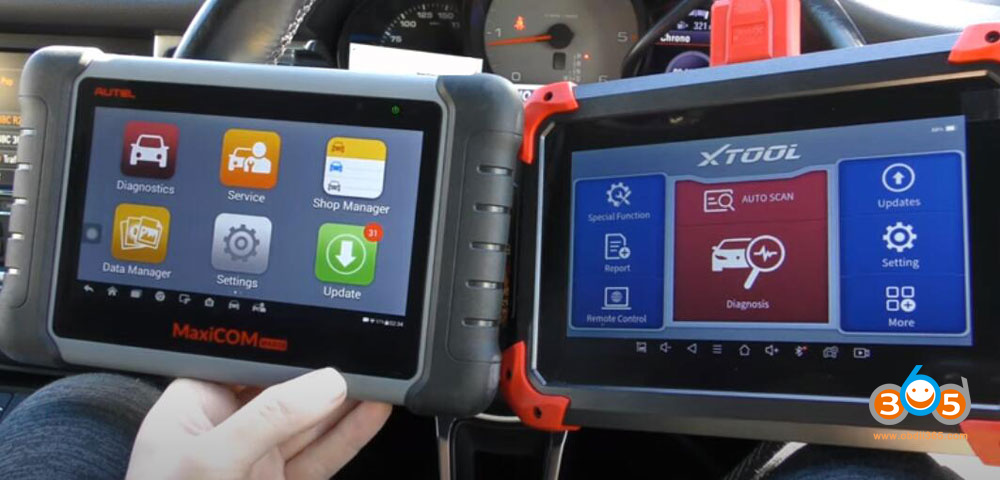
XTOOL D7 Overview
The XTOOL D7 is a tablet-style diagnostic scanner designed for technicians who need more than code reading. It commonly includes full-system diagnostics, live data, special functions, and bidirectional controls.
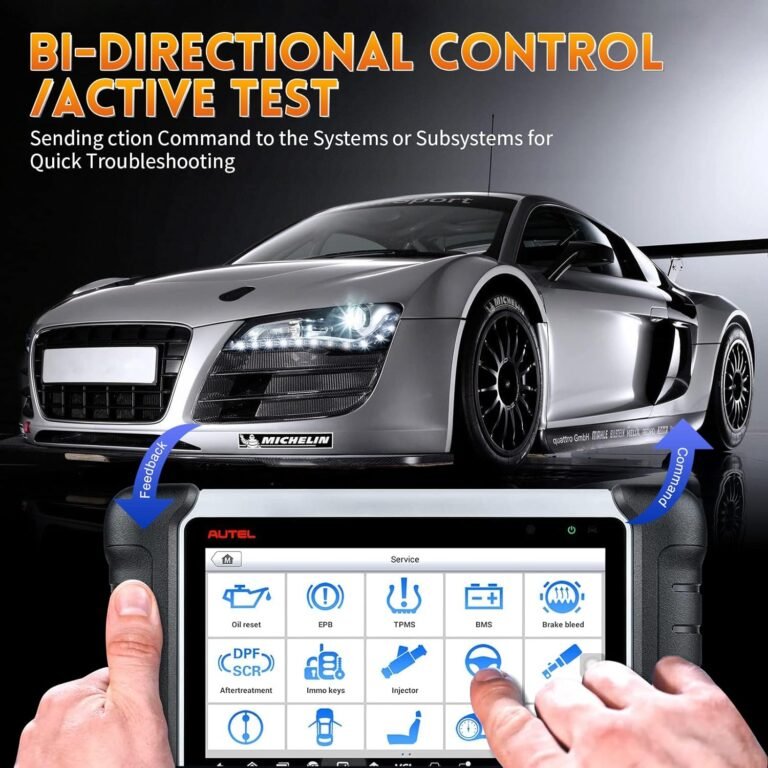
Bidirectional control means the scanner can send commands to a vehicle module. For example, it may command a cooling fan, fuel pump, relay, injector, window motor, or actuator to operate. This can help separate an electrical problem from a mechanical problem.
The XTOOL D7 usually includes functions such as:
• Read and erase diagnostic trouble codes
• View live sensor data
• Display data as graphs
• Perform active tests
• Reset oil service lights
• Register or reset battery systems
• Calibrate steering angle sensors
• Retract electronic parking brakes
• Regenerate diesel particulate filters when supported
• Reset throttle or transmission adaptations on selected vehicles
• Scan all available control modules
• Generate diagnostic reports
The strongest reason to consider the XTOOL D7 is its diagnostic depth. It can be useful when a basic scanner tells you that a fault exists but does not give you enough control to test the system.
Still, coverage is not universal. A bidirectional function listed in the product description may not work on every vehicle. Factory access, vehicle communication protocols, and software support all matter.

Source: obdii365.com
Autel MK808 Overview
The Autel MK808 is a compact diagnostic tablet aimed at service shops, mobile technicians, and serious vehicle owners. It is known for a clean interface and a practical set of repair functions.
The MK808 can usually perform:
• Engine, transmission, ABS, and airbag scans
• Full-system health reports
• Live data viewing
• Code reading and clearing
• Oil service resets
• Battery registration on supported vehicles
• Electronic parking brake service
• Steering angle calibration
• Diesel particulate filter service on selected vehicles
• Throttle relearn functions
• Tire pressure-related functions on some versions
The Autel MK808 is often easier for a new user to learn. Menus are clear, and the software guides you through many common service jobs. This matters in a busy garage, where time spent searching through menus can quickly add up.
Its main limitation is that the standard MK808 is not the same as a higher-level Autel diagnostic platform. It may not provide the same depth of active tests, coding, topology views, or advanced programming found on more expensive models.

Source: youtube.com
Diagnostic Coverage and System Scanning
Both scanners can access far more than the engine computer on many modern vehicles. This is important because a warning light may be caused by a module outside the powertrain.
For example, a communication fault may involve:
• ABS
• Airbag
• Body control
• Instrument cluster
• Transmission
• Electric power steering
• Parking brake
• Climate control
• Tire pressure monitoring
The XTOOL D7 vs Autel MK808 comparison becomes more interesting during a full-system scan. The D7 often feels more suitable for a technician who wants to inspect many systems and perform follow-up tests. The MK808 works well when the goal is to find stored codes and complete common service tasks.
In real repair work, a full scan should be saved before codes are cleared. This report can show whether a fault is current, historic, or related to low battery voltage.
A useful workflow is:
- Record the customer’s complaint.
- Check battery voltage.
- Perform a vehicle-wide scan.
- Save the original report.
- Inspect freeze-frame data.
- Test the related circuit.
- Repair the cause.
- Clear codes and complete a road test.
- Scan again to confirm the repair.
Neither tool replaces a wiring diagram, multimeter, pressure gauge, or mechanical inspection. A code identifies a system or condition. It does not always identify the failed part.

Source: diagmart.com
Bidirectional Controls and Active Tests
Bidirectional testing is one of the most important differences in the XTOOL D7 vs Autel MK808 debate.
With an active test, the scanner may ask a module to turn a component on or off. This can save time during diagnosis. For example, if you command a radiator fan and hear nothing, you can inspect the fuse, relay, wiring, fan motor, and control signal.
The XTOOL D7 is generally the stronger choice for users who need frequent active tests. It may offer commands for components such as:
• Cooling fans
• Fuel pumps
• Relays
• Solenoids
• Injectors
• Door locks
• Windows
• Horns
• Lights
• EVAP components
• HVAC actuators
The Autel MK808 can also support active tests on many vehicles, but the range may be narrower. The available menu is controlled by the vehicle manufacturer and model. A function may appear on one vehicle but not another.
One common mistake is assuming that an active test proves a component is good. It does not. If a fuel pump runs during a command, you still need to check fuel pressure, current draw, flow, and wiring. Think of an active test as a controlled question, not the final answer.
Source: obdii365.com
Service Functions and Resets
For routine maintenance, both tools can be useful. The right choice depends on the services you perform most often.
Common service functions include:
• Oil life reset
• Battery registration
• Electronic parking brake reset
• Steering angle sensor calibration
• Throttle relearn
• Diesel particulate filter regeneration
• Tire pressure system service
• Injector coding
• Transmission adaptation reset
• Suspension level calibration
The Autel MK808 is a strong fit for a shop that mainly performs oil resets, brake service, battery replacement, and basic module scans. Its straightforward layout can make these jobs quick.
The XTOOL D7 may be the better fit when service work overlaps with deeper diagnosis. For example, after replacing an electronic throttle body, you may need to run a relearn and inspect live data. The D7’s wider diagnostic approach can be helpful in that situation.
However, service functions can carry risk. Never start a DPF regeneration in an unsafe area. Do not perform battery registration without confirming the battery type and capacity. Follow the vehicle maker’s procedure, and connect a stable battery charger when required.

Source: youtube.com
Vehicle Coding, Adaptations, and Programming
Coding and programming are often confused, but they are not the same.
Coding changes configuration settings in a module. Examples include enabling equipment, matching a replacement module, or changing certain vehicle options.
Adaptations teach a module new values. Examples include throttle learning, transmission clutch adaptation, or steering angle calibration.
Programming writes new software to a control module. It may be needed after replacing a module or correcting a software issue.
The XTOOL D7 vs Autel MK808 comparison is less clear in this area because support varies greatly by vehicle. Neither tool should be treated as a universal programming device.
Before attempting coding or programming:
• Confirm the vehicle battery is fully supported by a charger.
• Use a stable wired connection when recommended.
• Check the exact vehicle software coverage.
• Record the original coding.
• Do not interrupt communication.
• Follow the manufacturer’s instructions.
A failed programming session can create a vehicle that will not start. For this reason, advanced module work is best handled by a trained technician with factory information and a recovery plan.

Source: obdii365.com
User Interface and Ease of Use
The Autel MK808 is usually easier for beginners. Its menus follow a familiar path: identify the vehicle, choose a system, scan for codes, and view data.
The XTOOL D7 may require more time to learn because it exposes more tests and functions. That extra depth is useful, but it can also make the tablet feel busy.
From a practical standpoint, the best interface depends on your working style:
• Choose Autel if you want a simple path for common service jobs.
• Choose XTOOL if you want more diagnostic control.
• Choose either tool if you value a tablet screen over a small handheld reader.
• Test the demo software if possible before buying.
A lesson I have learned from comparing scan tools is that a powerful menu is only useful when you understand the test. New users often select every available function without first checking the wiring diagram or symptom. That approach creates confusion rather than saving time.

Source: youtube.com
Hardware, Updates, and Software Costs
Hardware specifications can change by production batch and regional package. Check the current listing for screen size, memory, processor, battery, included cables, and update terms.
The buying price is only part of the cost. Diagnostic tools may also involve:
• Annual software updates
• Technical support plans
• Vehicle coverage upgrades
• Replacement cables
• Protective cases
• Battery chargers
• Manufacturer-specific access
Update policies can change, so do not rely on an old review when comparing the XTOOL D7 vs Autel MK808. Check whether the advertised update period is included, optional, or limited to certain features.
A tool with inexpensive hardware may cost more over several years if updates are expensive. On the other hand, a higher-priced tool may pay for itself if it prevents one unnecessary parts replacement.
For a small shop, estimate the return on investment. If the scanner helps diagnose two extra jobs each month, it may quickly become worthwhile. If you only need an oil reset a few times each year, a less expensive service tool may be enough.

Source: obdii365.com
XTOOL D7 vs Autel MK808 for DIY Users
For a DIY owner, the best scanner is the one that matches skill level and vehicle needs.
The Autel MK808 is a good choice for someone who wants to:
• Read check engine codes
• Check ABS and airbag faults
• View sensor readings
• Reset service indicators
• Register a new battery
• Perform basic maintenance procedures
The XTOOL D7 is better for a DIY user who wants to learn deeper testing. It can be useful when working on several vehicles or when a fault requires active tests.
For example, suppose a car has an intermittent cooling problem. The MK808 may show engine temperature data and stored codes. The XTOOL D7 may also let you command the fan and observe the system response. You still need to test the fuse, relay, wiring, and fan motor, but the command function can narrow the search.
Do not buy a professional scanner simply because it has the longest feature list. Buy the tool that you will use correctly.
XTOOL D7 vs Autel MK808 for Professional Shops
A professional shop usually needs speed, coverage, reporting, and reliable support. The XTOOL D7 may offer better value for a general repair shop that performs electrical diagnosis and active tests.
The Autel MK808 may be a better fit for a shop focused on:
• Routine maintenance
• Brake service
• Battery replacement
• Pre-purchase inspections
• General code scanning
• Basic European and Asian vehicle service
A busy shop may eventually need more than either tool. Advanced topology mapping, key programming, online coding, and full module programming often require a higher-level scanner or factory subscription.
One practical tip is to keep a second scan tool available. No aftermarket scanner covers every vehicle equally well. When one tool cannot access a module, a second brand can save a customer visit and prevent unnecessary guessing.
Strengths and Limitations
XTOOL D7 strengths
• Strong bidirectional diagnostic focus
• Broad service function coverage
• Useful live data and graphing tools
• Good fit for electrical troubleshooting
• Full-system scanning on supported vehicles
• Helpful for advanced DIY users and independent shops
XTOOL D7 limitations
• Some functions may require paid updates
• Coverage differs between vehicle brands
• The interface may take time to learn
• It is not a universal programming tool
• Product specifications can vary by package or region
Autel MK808 strengths
• Simple and familiar interface
• Good coverage for common service jobs
• Full-system scanning on supported vehicles
• Useful live data functions
• Compact tablet design
• Suitable for many DIY owners and general repair shops
Autel MK808 limitations
• Standard models may have fewer active tests
• Advanced coding and programming are limited
• Wireless features may depend on the exact model
• Update costs can affect long-term value
• Some functions require manufacturer-level access
The most important limitation in the XTOOL D7 vs Autel MK808 comparison is vehicle coverage. A scanner may be excellent on one brand and average on another. Always check coverage for the vehicles you service most.
Which Scanner Should You Buy?
Choose the XTOOL D7 if:
• You want stronger bidirectional testing.
• You diagnose electrical and sensor faults.
• You work on several vehicle brands.
• You need more than basic service resets.
• You are comfortable learning advanced menus.
Choose the Autel MK808 if:
• You want an easy-to-use diagnostic tablet.
• You mainly perform routine maintenance.
• You need full-system scans and live data.
• You prefer a familiar interface.
• You want a practical tool for home or general shop use.
The XTOOL D7 vs Autel MK808 decision may also depend on your most common vehicle. Before purchasing, check coverage by year, make, model, engine, and system. Do not rely only on a general statement such as “supports all systems.”
How to Use Either Tool Safely
A scan tool connects to important vehicle systems. Careless use can cause problems, especially during coding or programming.
Follow these steps:
- Park the vehicle safely.
- Turn off large electrical loads.
- Check battery voltage.
- Connect the scanner securely.
- Identify the vehicle by VIN, then confirm the details.
- Save the original scan report.
- Read codes before clearing them.
- Review freeze-frame data and live values.
- Test the system before replacing parts.
- Clear codes only after repairs.
- Road-test the vehicle safely.
- Perform a final scan.
Never clear a code simply to turn off a warning light. That erases information without fixing the cause. Also, never work around an airbag system without following proper safety procedures.
Industry diagnostic standards and vehicle manufacturer service information both support a test-before-replace approach. This reduces comebacks, saves money, and protects the customer from unnecessary repairs.
Common Mistakes to Avoid
Many scanner problems are caused by the user, not the tool.
Avoid these mistakes:
• Buying the wrong model variant.
• Skipping battery voltage checks.
• Clearing codes before saving the report.
• Replacing a sensor based only on one code.
• Assuming every active test works on every vehicle.
• Using a weak battery during module work.
• Starting a DPF regeneration indoors.
• Ignoring technical service bulletins.
• Treating aftermarket coverage as equal to factory coverage.
• Forgetting to confirm a repair with a second scan.
A code such as P0171 may indicate a lean condition, but it does not automatically mean the oxygen sensor has failed. A vacuum leak, low fuel pressure, dirty injector, or air measurement problem may create the same code.
This is where experience matters. The scanner gives you clues. Good diagnosis connects those clues with symptoms, test results, and service information.
Frequently Asked Questions: XTOOL D7 vs Autel MK808
Is the XTOOL D7 better than the Autel MK808?
The XTOOL D7 is generally better for bidirectional tests and deeper troubleshooting. The Autel MK808 is often better for simple service work and an easier user experience.
Can the XTOOL D7 perform active tests?
Yes, the XTOOL D7 supports active tests on many compatible vehicles. Available commands depend on the vehicle’s control modules and the software coverage for that model.
Does the Autel MK808 support bidirectional control?
Some MK808 versions support bidirectional functions, but coverage may be more limited than the XTOOL D7. Confirm the exact MK808 model and vehicle application before buying.
Can either scanner program a car key?
Neither the standard XTOOL D7 nor the standard Autel MK808 should be assumed to provide universal key programming. Key work often requires a dedicated tool, security access, online authorization, or manufacturer software.
Can these scanners reset an electronic parking brake?
Yes, both tools can perform electronic parking brake service on many supported vehicles. Always use a battery charger and follow the vehicle’s brake service procedure.
Do both tools work with all cars?
No. Coverage varies by make, model, year, engine, control module, and software version. Check the manufacturer’s current coverage list before purchasing.
Which is easier for beginners?
The Autel MK808 is usually easier for beginners because its menus are simple and focused on common service functions. The XTOOL D7 can also be user-friendly, but its larger feature set takes more practice.
Conclusion
The XTOOL D7 vs Autel MK808 choice comes down to diagnostic depth versus simplicity. The XTOOL D7 is the stronger option for active tests, electrical troubleshooting, and advanced service work. The Autel MK808 is a practical choice for full-system scans, live data, and common maintenance tasks.
Before you buy, check current vehicle coverage, update costs, included accessories, and the exact model variant. Use the scanner as part of a complete testing process, not as a replacement for service information or hands-on inspection.
Choose the tool that matches your vehicles and repair goals, then build your skills with every scan. Share your experience or questions about the XTOOL D7 vs Autel MK808 in the comments.