NOCO Genius10 Vs Battery Tender Plus: Which Wins?
NOCO Genius10 is the better choice for speed, power, battery variety, and recovery, while Battery Tender Plus suits simple maintenance.
Choosing between the NOCO Genius10 vs Battery Tender Plus depends on how you use your vehicle and battery. I have compared smart chargers by charging speed, battery support, safety, ease of use, and long-term value, and the difference here is clear: one is a powerful multi-use charger, while the other is a gentle maintenance tool.
NOCO Genius10 vs Battery Tender Plus at a Glance
The NOCO Genius10 and Battery Tender Plus both use automatic charging technology. They monitor battery voltage and adjust the charge as the battery fills. This helps prevent the overcharging that older, basic battery chargers could cause.
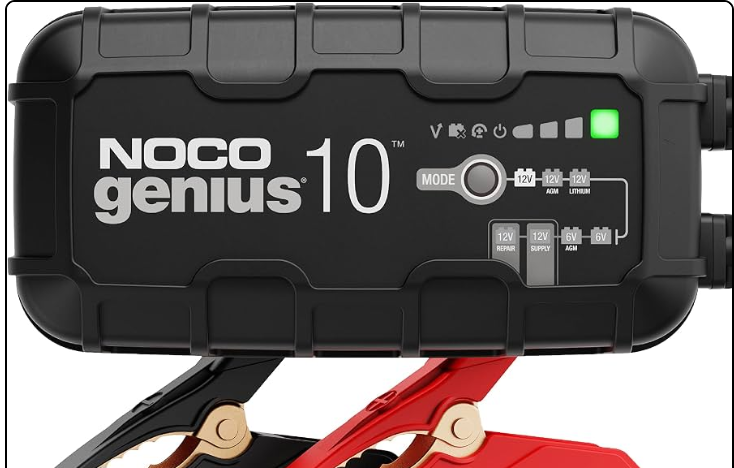
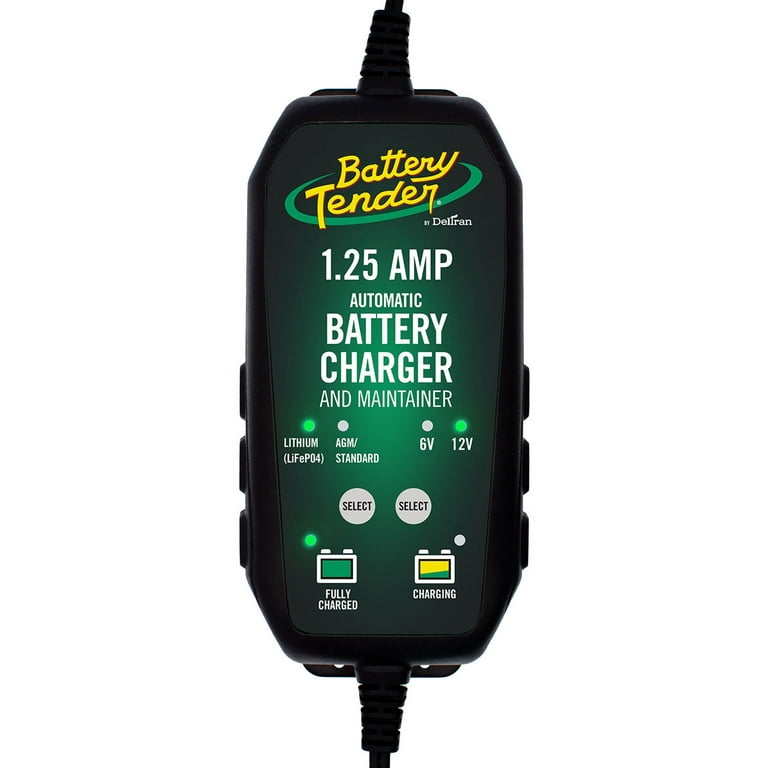
However, they serve different users. The NOCO Genius10 is a 10-amp charger for cars, trucks, motorcycles, boats, RVs, and many other vehicles. The Battery Tender Plus is a 1.25-amp maintainer designed mainly for smaller 12-volt lead-acid batteries.
| Feature | NOCO Genius10 | Battery Tender Plus |
|---|---|---|
| Maximum output | 10 amps | 1.25 amps |
| Battery voltage | 6V and 12V | 12V |
| Main battery types | Lead-acid and LiFePO4 lithium | Lead-acid, AGM, and gel |
| Best use | Charging, recovery, and maintenance | Long-term maintenance |
| Lithium support | Yes, with the correct mode | Usually no |
| Small battery use | Yes, with care | Excellent |
| Large battery use | Much better | Slow |
| Charge stages | Smart multi-stage charging | Automatic four-step charging |
| Repair mode | Yes | No dedicated repair mode |
| Portability | Compact but more powerful | Very light and simple |
| Warranty | Limited warranty varies by region | Long limited warranty varies by region |
The NOCO Genius10 vs Battery Tender Plus comparison becomes easier when you think of them as two different tools. The NOCO is closer to a workshop charger. The Battery Tender Plus is closer to a slow drip system that keeps a healthy battery ready.

NOCO Genius10 vs Battery Tender Plus: Charging Speed
Charging speed is the largest difference between these two products. The NOCO Genius10 can deliver up to 10 amps, while the Battery Tender Plus delivers up to 1.25 amps.
A simple estimate helps show the gap. A 60 amp-hour car battery that is deeply discharged may need many hours with either charger. Under ideal conditions, 10 amps can restore it far faster than 1.25 amps. Real charging takes longer because the charger reduces current as the battery reaches full charge.
The Battery Tender Plus is not designed to recharge a large, flat automotive battery quickly. It is designed to maintain a battery that is already fairly full. Think of it as a slow stream, not a fire hose.
The NOCO Genius10 is better when:
• Your car battery is low after sitting for weeks
• You need to prepare a vehicle for regular driving
• You own a truck, SUV, boat, or RV
• You want one charger for several battery sizes
• You need a faster top-up before a trip
The Battery Tender Plus is better when:
• Your vehicle sits in a garage for long periods
• Your battery loses charge slowly over time
• You maintain a motorcycle or classic car
• You do not need fast charging
• You want a simple plug-in maintainer
In my experience, one common mistake is buying a 1.25-amp maintainer and expecting it to act like a full car battery charger. It can charge a battery, but the process may take a very long time. If the battery is badly drained, the charger may also refuse to start because the voltage is too low.
Battery Compatibility and Voltage Modes
The NOCO Genius10 supports both 6-volt and 12-volt batteries. This gives it an advantage for older vehicles, lawn equipment, some powersports products, and special applications.
It supports several common battery types, including:
• Flooded lead-acid batteries
• Sealed lead-acid batteries
• AGM batteries
• Gel batteries
• EFB batteries
• Lithium-ion batteries designed for starting or deep-cycle use, especially LiFePO4 types
The correct lithium mode matters. A lithium battery must have a battery management system, often called a BMS. The BMS helps protect the cells from unsafe conditions. You should never use a lithium charging mode on a battery that is not approved for that chemistry.
The Battery Tender Plus is mainly intended for 12-volt lead-acid batteries. This includes many flooded, AGM, and gel batteries. The exact supported battery type can depend on the model, so check the label and manual before connecting it.
The Battery Tender Plus is not the better choice for modern lithium batteries unless you own a specific lithium-compatible version. Using the wrong charging profile can reduce battery life or create a safety risk.
This is one of the strongest points in the NOCO Genius10 vs Battery Tender Plus decision. If you have both lead-acid and lithium batteries, the NOCO offers much more flexibility. If you only have a standard 12-volt lead-acid battery, the Battery Tender Plus may provide everything you need.
Source: walmart.com
NOCO Genius10 vs Battery Tender Plus: Battery Maintenance
Both chargers can maintain a battery after it reaches full charge. They do this by watching voltage and supplying current only when needed.
The Battery Tender Plus has a strong reputation as a long-term maintainer. It charges the battery, switches to float mode, and checks the battery from time to time. This makes it useful for motorcycles, collector cars, seasonal vehicles, and lawn tractors.
The NOCO Genius10 also supports long-term maintenance. Its smart system monitors the battery and changes its output as conditions change. It can remain connected for extended periods when used correctly and when the battery is suitable.
The key difference is power. Ten amps does not mean the NOCO constantly pushes ten amps into the battery. The charger provides current based on battery demand. Once the battery is full, it shifts into a maintenance pattern.
For winter storage, both products can work well. Follow these steps:
- Clean the battery terminals.
- Confirm the battery voltage and chemistry.
- Connect the clamps or ring terminals correctly.
- Plug the charger into the wall after making the battery connection.
- Confirm that the correct charging light or mode is active.
- Keep the charger and battery in a dry, ventilated area.
- Inspect the setup from time to time.
A maintainer cannot fix a battery with a shorted cell. If the battery drops voltage quickly after charging, the battery may be worn out rather than merely discharged.

Source: amazon.ae
Safety Features and Ease of Use
The NOCO Genius10 includes several useful safety features. These commonly include spark-resistant connections, reverse-polarity protection, short-circuit protection, and automatic monitoring.
The charger also uses mode buttons. This gives you more control, but it means you must select the correct setting. A wrong mode can lead to poor charging or battery damage.
The Battery Tender Plus is simpler. It usually uses a basic connection system and LED indicators to show charging or maintenance status. Its low output also makes it gentle on small batteries.
Simplicity can be a safety feature. There are fewer settings to select and fewer chances to choose the wrong mode. On the other hand, the NOCO gives you more information and more control when you need it.
Before using either charger:
• Read the battery label.
• Check for cracks, swelling, leaks, or heat damage.
• Do not charge a frozen battery.
• Keep sparks and flames away from lead-acid batteries.
• Use the correct battery chemistry mode.
• Do not cover the charger while it is operating.
• Stop if the battery becomes unusually hot or smells strongly.
I have seen people connect a charger to a battery without checking polarity. That small mistake can damage equipment. The safest habit is simple: identify the positive and negative terminals before you connect anything.
NOCO Genius10 vs Battery Tender Plus for Cars and Trucks
For a normal daily driver, either charger may be useful. The better choice depends on whether you want maintenance or active charging.
The Battery Tender Plus works well for a car that sits for a week or two at a time. It can help offset the small electrical drain from vehicle computers, alarms, and remote systems. It is also a good fit for a second car that spends most of its time parked.
The NOCO Genius10 is more useful for larger vehicles and deeper discharge. A truck with a large battery may take too long to recover with a 1.25-amp charger. The 10-amp output gives the NOCO a much more practical charging range.
The NOCO is also useful if your vehicle battery has been drained by:
• Leaving headlights on
• Running an interior light
• Using a power inverter
• Sitting unused for several months
• Cold weather
• A door or trunk that did not close fully
A charger is not a substitute for diagnosis. If your car needs charging every few days, test the battery and alternator. A weak alternator, poor ground, parasitic drain, or old battery may be the real cause.
For a family with several vehicles, the NOCO Genius10 may be the better long-term purchase. It can cover more situations without needing a second charger.

Source: amazon.sg
NOCO Genius10 vs Battery Tender Plus for Motorcycles
Motorcycles often have smaller batteries, so the Battery Tender Plus has a natural advantage. Its 1.25-amp output is gentle and suitable for many 12-volt motorcycle batteries.
The NOCO Genius10 can also maintain motorcycle batteries, but you must select the correct mode. A high-output charger does not automatically force ten amps into a small battery. Still, a powerful charger requires more attention from the user.
For a motorcycle stored during winter, look for these features:
• A compatible 12-volt charging mode
• Ring-terminal or quick-connect cables
• Automatic float maintenance
• Reverse-polarity protection
• A weather-resistant design
The Battery Tender Plus often includes a fused ring-terminal harness. This makes it easy to mount the cable near the battery and connect the charger without removing the seat each time.
The NOCO Genius10 has similar accessory options, but its setup may feel more advanced. If you only own one motorcycle and want a simple storage solution, the Battery Tender Plus is hard to dismiss.
If you own a motorcycle with a lithium battery, the NOCO is the safer choice only when you use its approved lithium mode. Confirm the battery manufacturer’s instructions first.
NOCO Genius10 vs Battery Tender Plus for RVs, Boats, and Lawn Equipment
Larger batteries and deep-cycle applications favor the NOCO Genius10. Its higher output can reduce charging time for many marine, RV, and recreational batteries.
The NOCO is especially useful for:
• Marine starting batteries
• 12-volt deep-cycle batteries
• RV house batteries
• Utility vehicles
• Riding mower batteries
• Snowmobiles and ATVs
The Battery Tender Plus can maintain these batteries once they are charged, but it may not be practical for recovering a large battery from a low state. A 1.25-amp charger may need a full day or longer, depending on battery size and condition.
For a boat or RV, check whether the battery bank uses one 12-volt battery or multiple batteries wired together. A 24-volt or 36-volt bank needs a charger designed for that system. Do not connect a 12-volt charger to a higher-voltage battery bank.
The NOCO Genius10 vs Battery Tender Plus choice also depends on whether you need lithium support. Many newer RV and marine systems use LiFePO4 batteries. The NOCO has a major advantage in this area, but the charger must match the battery’s instructions.

Source: amazon.ae
Repair and Low-Voltage Charging
One special feature of the NOCO Genius10 is its repair mode. This mode may help certain lead-acid batteries that have sulfation or reduced performance. It uses a higher-voltage process intended to improve battery condition.
Repair mode has limits. It cannot restore a battery with damaged plates, a shorted cell, severe corrosion, or physical swelling. It also should not be used casually on every battery.
The NOCO may also offer a force or low-voltage function for batteries that are deeply discharged. This function requires care because the charger may not detect the battery in the normal way. Read the instructions before using it.
The Battery Tender Plus does not offer the same recovery features. Its purpose is steady charging and maintenance, not battery repair.
A useful rule is:
• Use repair mode only on compatible lead-acid batteries.
• Disconnect the battery from sensitive vehicle electronics when the manual recommends it.
• Do not use repair mode on lithium batteries.
• Replace a battery that remains weak after a full charge and proper test.
Battery sulfation often develops when a lead-acid battery stays partly discharged. A smart charger can help prevent that condition, but it cannot reverse every type of damage.
Build Quality, Weather Use, and Warranty
The NOCO Genius10 has a rugged, compact design and a weather-resistant housing. It is suitable for garage, driveway, and workshop use, but weather-resistant does not mean that you should leave it in heavy rain or standing water.
The Battery Tender Plus is also built for regular garage and storage use. Many versions are compact and easy to hang or place near a motorcycle. Keep the charger dry and protect the plug connection from moisture.
Warranty terms can change by model and region. Check the current product packaging and manufacturer information before buying. A longer warranty is helpful, but proper battery selection and safe use matter more.
During hands-on charger comparisons, cable quality often matters as much as the main unit. Short, stiff cables make connection difficult. A fused ring-terminal lead can make seasonal maintenance much easier.
Consider the following before purchase:
• Cable length
• Clamp quality
• Ring-terminal accessories
• Replacement cable availability
• Indicator visibility
• Storage space
• Warranty coverage
Which Charger Offers Better Value?
The Battery Tender Plus usually costs less than the NOCO Genius10. It offers good value when your needs are narrow and clear.
Choose the Battery Tender Plus if:
• You want to maintain one 12-volt lead-acid battery.
• Your vehicle is stored for long periods.
• You rarely need fast charging.
• You prefer simple controls.
• You mainly maintain a motorcycle or small car battery.
Choose the NOCO Genius10 if:
• You want one charger for several vehicles.
• You need faster charging.
• You work with 6-volt and 12-volt batteries.
• You own lithium and lead-acid batteries.
• You want repair and low-voltage functions.
• You maintain trucks, boats, RVs, or larger batteries.
The most expensive charger is not always the best charger. A Battery Tender Plus can be the smarter buy for a motorcycle owner who only needs winter maintenance. The NOCO Genius10 can be the better investment for a household with different battery types.
Common Mistakes to Avoid
Many battery charger problems come from setup errors rather than product defects. Avoiding a few mistakes can protect both the charger and battery.
• Do not select lithium mode for a lead-acid battery.
• Do not use a 12-volt charger on a 6-volt battery.
• Do not charge a visibly damaged or leaking battery.
• Do not assume a green light proves the battery is healthy.
• Do not place the charger where it can get wet.
• Do not leave loose clamps where they can touch each other.
• Do not use a repair mode as a cure for a dead battery.
• Do not ignore a repeated low-battery problem in your vehicle.
A green maintenance light means the charger sees an acceptable charging condition. It does not guarantee that the battery can deliver its rated starting power. A battery can show normal voltage and still fail under a load test.
For the best result, charge the battery fully, then have it tested if the vehicle still cranks slowly. This simple step prevents many unnecessary battery replacements.
How to Choose Between NOCO Genius10 vs Battery Tender Plus
Start with the battery, not the charger. Check its voltage, chemistry, capacity, and intended use.
Use this process:
- Identify the battery voltage.
- Confirm whether it is lead-acid, AGM, gel, EFB, or lithium.
- Estimate how often the battery needs charging.
- Decide whether speed matters.
- Consider the largest battery you may need to charge.
- Check whether you need repair or low-voltage features.
- Review cable and accessory needs.
If you maintain one small battery, the Battery Tender Plus is simple and efficient. If you want more power and broader compatibility, the NOCO Genius10 is the stronger all-around option.
The NOCO Genius10 vs Battery Tender Plus debate is not really about which brand is best. It is about matching the charger to the job. A small maintainer can be perfect for storage, while a 10-amp smart charger can save hours when a larger battery needs help.
Frequently Asked Questions About NOCO Genius10 vs Battery Tender Plus
Is the NOCO Genius10 better than the Battery Tender Plus?
The NOCO Genius10 is better for faster charging, larger batteries, 6-volt systems, and lithium compatibility. The Battery Tender Plus is better for simple, long-term maintenance of a 12-volt lead-acid battery.
Can the NOCO Genius10 charge a motorcycle battery?
Yes, the NOCO Genius10 can charge many motorcycle batteries when the correct voltage and battery type mode are selected. Use care with small batteries and follow the motorcycle battery manufacturer’s instructions.
Can the Battery Tender Plus charge a car battery?
Yes, it can charge and maintain many 12-volt car batteries, but its 1.25-amp output makes it slow for a deeply discharged or large battery. It is best used as a maintainer or low-current charger.
Does the NOCO Genius10 support lithium batteries?
The NOCO Genius10 supports compatible lithium batteries, especially LiFePO4 types, when its lithium mode is selected. The battery must have the required protection system and must be approved for this charging method.
Can I leave the NOCO Genius10 connected overnight?
The NOCO Genius10 is designed for automatic charging and maintenance, so overnight use is normally appropriate when the battery and mode are correct. Keep the charger dry, ventilated, and connected according to the manual.
Can I use Battery Tender Plus on an AGM battery?
Most Battery Tender Plus models support 12-volt AGM batteries. Confirm the exact model instructions, because product versions can differ.
Does the NOCO Genius10 repair dead batteries?
Its repair function may help some worn or sulfated lead-acid batteries, but it cannot fix every failed battery. A shorted cell, severe damage, or physical swelling usually means the battery needs replacement.
Which is better for winter storage?
Both can work well for winter storage. Choose the Battery Tender Plus for a single 12-volt lead-acid battery and choose the NOCO Genius10 if you need more battery types, faster charging, or stronger recovery features.
Conclusion
The NOCO Genius10 is the more powerful and flexible charger. It supports 6-volt and 12-volt batteries, charges faster, works with more battery types, and includes useful recovery features.
The Battery Tender Plus remains a smart choice for simple maintenance. Its low 1.25-amp output is gentle, easy to use, and well suited to motorcycles, classic cars, and seasonal vehicles with 12-volt lead-acid batteries.
Choose the charger that matches your real needs. If you want one tool for many vehicles, select the NOCO Genius10. If you only need a dependable storage maintainer, the Battery Tender Plus may save money and reduce complexity. Check your battery type before buying, and share your experience or questions in the comments.