10 Best Professional Chef Knife
There’s no single best professional chef knife for every kitchen. The right tool depends on your cutting style, how you grip a handle, and the blade size your prep space allows. Some cooks want heavy German steel with a thick bolster that powers through tough squashes, while others prefer thin Japanese blades with acute edge angles that slice herbs cleanly. These knives differ in balance, edge hardness, and blade length rather than basic quality. If you want a classic heavy German workhorse, look at the WÜSTHOF Classic Chef’s Knife, but if you want thin, ultra-sharp Japanese layered steel, consider the Shun Premier Chef’s Knife.
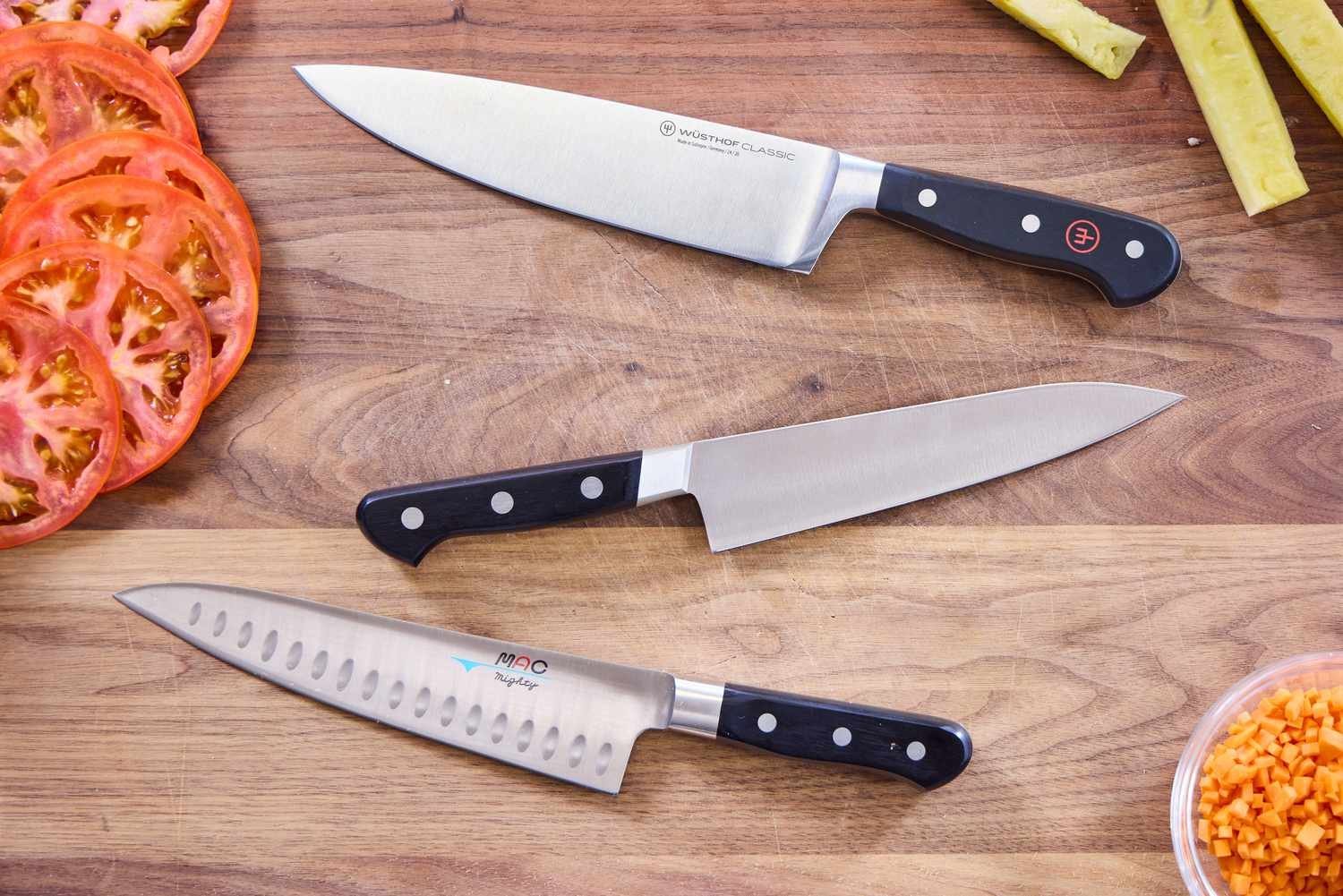
1. WÜSTHOF Classic 8 Inch Chef’s Knife

Best for: someone who preps tough root vegetables and meat every single day.
This German-made knife features a full tang, triple-riveted synthetic handle and weighs 8.5 ounces. It’s precision-forged from a single block of high-carbon stainless steel tempered to 58 HRC. The thick full bolster and finger guard add safety and forward weight, which helps when you push down through dense squash. However, that solid heel prevents you from sharpening the entire length of the cutting edge flat against a whetstone.
Its 8-inch blade uses Precision Edge Technology (PEtec) to maintain a durable edge during long prep sessions. The 4.5-inch handle resists fading and discoloration over years of kitchen work. Because of its heavier German profile and thick bolster, this knife isn’t ideal for cooks who prefer light, paper-thin Japanese blades for delicate push-cutting.
Good if: – You prefer a heavier knife that uses its own weight to cut. – You want a full finger guard to protect your hand. – You need a durable handle that resists moisture and fading.
Skip it if: – You sharpen your knives on flat whetstones and hate thick bolsters. – You prefer featherweight cutlery for quick, delicate slicing.
2. Shun Premier 8″ Chef’s Knife

Best for: a home cook who wants thin, precise Japanese slicing performance.
Handcrafted in Japan, this knife features a cutting core of VG-MAX steel clad in 68 layers of Damascus steel. It’s ground to a sharp 16-degree edge that slides through tender meats and crisp produce without tearing cells. The hammered tsuchime finish creates air pockets on the blade face, which reduces drag and prevents damp potato slices from sticking. That thin edge requires careful handling, so it isn’t built to chop through poultry bones.
The contoured handle uses moisture-resistant Pakkawood, shaped to fit both left- and right-handed users comfortably. Shun backs the knife with free sharpening and honing services if you send it in. It isn’t designed for cooks who want a dishwasher-safe tool or something to hack through frozen foods.
Good if: – You cut lots of moist vegetables and hate food sticking to the blade. – You want a thin factory edge designed for clean precision. – You value free factory sharpening support from the maker.
Skip it if: – You tend to twist the blade or scrape cutting boards with the edge. – You want a knife that can handle heavy butchery and split bone.
3. Victorinox Fibrox Pro 8 Inch Chef’s Knife

Best for: someone who wants an easy-care knife with a reliable wet grip.
This Swiss-made workhorse has a stainless steel blade with a tapered cutting edge. Its handle is molded from thermoplastic elastomer (TPE), giving you a secure, non-slip hold even when your fingers are wet or greasy. The knife is weighted and balanced for easy handling.
The materials are listed as dishwasher-safe, offering quick cleanup after messy meat prep, though hand washing preserves edges longer. Victorinox includes a lifetime warranty against defects in materials and workmanship. This knife isn’t for a buyer who wants traditional triple-riveted wood handles or heavy bolster balance.
Good if: – You often work with wet hands and need a slip-resistant handle. – You want a tool made from dishwasher-safe materials. – You prefer lightweight blades that don’t tire your forearm.
Skip it if: – You like the weighty, solid feel of a forged full-bolster knife. – You prefer ornate wooden handles and layered steel finishes.
4. ZWILLING Pro 10-inch Chef’s Knife

Best for: cooks who use a pinch grip and handle large produce daily.
This 10-inch knife gives you extra reach and a wide cutting surface for large cabbages and roasts. It’s forged from high-carbon stainless steel using the SIGMAFORGE process and ice-hardened with ZWILLING’s FRIODUR method. A curved bolster supports a natural pinch grip by letting your thumb and index finger rest easily against the steel. The extended 10-inch length provides huge cutting capacity, though it feels unwieldy on compact apartment cutting boards.
The durable POM handle features a classic three-rivet design bonded to a full tang. Laser-controlled honing ensures a consistent angle along the entire extended edge. It isn’t suitable for cooks working in cramped kitchens with small cutting boards.
Good if: – You use a pinch grip and want curved steel to support your fingers. – You regularly split large melons, cabbages, or large cuts of meat. – You want an ice-hardened blade that resists staining.
Skip it if: – Your prep area or cutting board is under 12 inches wide. – You struggle to control long, oversized chef knives.
5. Global 10″ Chef’s Knife

Best for: anyone who wants a completely seamless, hygienic knife with zero wood.
The Global 10-inch knife stands out because it’s constructed entirely from stainless steel from tip to butt. Its blade uses molybdenum/vanadium stainless steel that holds a razor-sharp edge over long prep cycles. The stainless handle is molded with dimples, providing a safe grip. Because it has no thick bolster or heavy pommel, the knife feels remarkably light, which changes how much downward arm pressure you must apply.
Its 10-inch length lets you slice across wide roasts in a single fluid motion. Global backs the knife with a lifetime warranty against defects and breakage. It isn’t built for cooks who find thin, all-metal handles slick or uncomfortable during cold prep shifts.
Good if: – You want a seamless, all-metal knife that leaves no cracks for grime. – You like a 10-inch blade that feels lighter than traditional German knives. – You want molybdenum/vanadium steel with strong edge retention.
Skip it if: – You prefer thick, rounded wooden or composite handles. – You want a short, compact blade for quick paring board tasks.
6. Dalstrong 8″ Japanese Chef Knife Gyuto

Best for: home cooks who want an ultra-sharp edge and striking presentation.
Part of the Shogun Series X, this 8-inch Gyuto combines an AUS-10V Japanese super steel core with 66 layers of Damascus cladding. The edge is hand-finished using the Honbazuke method to a narrow 8 to 12 degrees per side, making it scalpel-sharp. A vacuum heat treatment and nitrogen cooling bring the core to 62+ Rockwell hardness for edge retention.
A hammered tsuchime finish reduces surface drag, while the 55mm blade height offers generous knuckle clearance over the cutting board. Its military-grade G-10 handle has three rivets and resists heat and moisture. It isn’t for cooks who chop roughly through frozen blocks or hard bones.
Good if: – You want an acute 8-12 degree edge angle for thin slicing. – You need deep knuckle clearance above your cutting board. – You like the look of hammered steel and mosaic handle pins.
Skip it if: – You tend to use knives roughly on hard bones or frozen foods. – You want a thick, softer steel edge that bends rather than chips.
7. ZWILLING Professional S 8-inch Razor-Sharp German Chef’s Knife

Best for: traditionalists who want a standard 8-inch German profile with balance.
Manufactured in Germany, this knife features a traditional full tang, a three-rivet polymer handle, and a thick full bolster. It’s forged from a single piece of high-carbon no-stain steel and ice-hardened to 57 Rockwell hardness. The laser-controlled 15-degree edge per side balances sharpness with edge durability. The full bolster protects your fingers, but it also adds dead weight right at the heel.
The polymer handle resists moisture and seals flush against the tang for good hygiene. The listing notes that the knife is dishwasher-safe, giving you flexible cleanup options, though hand drying keeps the steel bright. It isn’t suitable for someone seeking a thin, nimble Japanese-style blade.
Good if: – You want a traditional German profile with a protective bolster. – You want steel balanced at 57 HRC that sharpens easily. – You need a sturdy full-tang knife with a classic polymer handle.
Skip it if: – You prefer sharpening without a bolster blocking your stones. – You want an ultra-light Japanese blade for delicate push-cuts.
8. HENCKELS Classic 8-Inch Chef Knife

Best for: cooks tackling heavy food prep, including cutting through joint cartilage.
This forged German knife is engineered with a fully forged construction and a seamless bolster-to-handle transition. Its satin-finished blade is finely honed for precision slicing, chopping, and mincing. The seller specifically notes it handles slicing vegetables as well as cutting through large slabs of meat and disjointing bones.
Its stain-resistant steel handles cleanup in the dishwasher or by hand. The fully forged build gives it structural rigidity from tip to heel. It isn’t designed for cooks wanting delicate, paper-thin sashimi slicing.
Good if: – You disjoint poultry joints and trim large roasts at home. – You prefer no-fuss cleanup options like dishwasher compatibility. – You want fully forged German engineering with a classic handle.
Skip it if: – You want an ultra-thin knife solely for delicate vegetable work. – You dislike thick bolsters when maintaining edges on stones.
9. Mercer Culinary M21078 Genesis 8-Inch Short Bolster Chef’s Knife

Best for: prep cooks who want forged balance combined with easy stone sharpening.
The Mercer Genesis features a short bolster design, giving you the balance of forged steel without the heel block that ruins whetstone sharpening. It’s precision-forged from high-carbon German steel with a taper-ground edge for smooth cutting through onions, shallots, and cabbage. Its built-to-last ergonomic handle provides a non-slip grip, even when your hands are wet. Because it must be washed by hand and towel-dried, it demands disciplined maintenance.
The knife balances durability and cutting efficiency for everyday professional or home use. Mercer warns not to submerge the knife in water or put it into a dishwasher. It isn’t for people who refuse to hand-wash their kitchen tools.
Good if: – You sharpen on whetstones and need an unblocked blade heel. – You need an ergonomic handle that offers a non-slip grip, even when wet. – You want high-carbon German forged steel.
Skip it if: – You insist on running your cutlery through an automatic dishwasher. – You prefer hard, polished composite handles over soft grips.
10. KYOKU Shogun Series
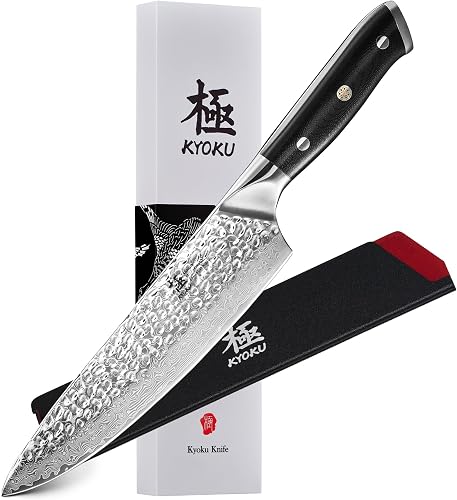
Best for: anyone who wants a complete storage kit with an acute Japanese edge.
This standard-length chef knife pairs a Japanese VG-10 steel core with 67 layers of Damascus steel, cryogenically treated to 58-60 HRC. It’s ground to a narrow 8 to 12 degrees per side using the 3-step Honbazuke method, slicing through meat and produce with minimal drag. A fiberglass handle with a mosaic pin resists temperature swings, moisture, and corrosion.
KYOKU includes a custom sheath and a protective case, making it easy to store in a shared drawer or pack for travel. Its ergonomic balance reduces wrist fatigue during long prep shifts. It isn’t built for cooks who chop into hard bones or frozen food.
Good if: – You need a sheath and case included for safe drawer storage. – You want a Japanese VG-10 Damascus core with high hardness. – You want an ultra-sharp 8-12 degree Honbazuke edge.
Skip it if: – You do heavy butchery where an acute edge might chip. – You prefer simple stamped steel blades without Damascus styling.
Where These Overlap
Several knives here share identical foundations. The WÜSTHOF Classic Chef’s Knife, ZWILLING Professional S, and HENCKELS Classic Chef Knife all feature forged German high-carbon stainless steel, triple-riveted polymer handles, and full protective bolsters. If you pick among those three, you’re choosing based on brand loyalty, handle contour, or minor weight differences.
Similarly, the Dalstrong Gyuto Chef Knife and the KYOKU Shogun Series both rely on hard Japanese steel cores clad in Damascus steel, hammered tsuchime finishes, and acute 8 to 12 degree Honbazuke edges. They cut with identical sharpness, leaving your decision down to whether you prefer Dalstrong’s wider knuckle clearance or KYOKU’s included sheath.
Still Not Sure?
How often will you sharpen your blade?
Hard Japanese blades hold their edge for a long time, but they require careful stone sharpening when they dull. German blades like the ZWILLING Professional S use slightly softer steel that dings instead of chipping, making them easy to touch up with a standard honing steel. If you want easy edge maintenance, choose the ZWILLING Professional S.
Do you prefer hand washing or quick cleanup?
High-carbon Damascus blades and wooden handles ruin quickly if they sit wet in a sink or cycle through high-heat appliances. Stamped blades with synthetic handles don’t mind moisture or rougher treatment. If you want a knife built with dishwasher-safe materials that grips even when wet, get the Victorinox Fibrox Pro.
What kind of food prep takes up your time?
Large squashes, cabbages, and thick root vegetables require a knife with forward heft and an unyielding spine to crack through dense flesh safely. Delicate herbs, soft tomatoes, and raw fish require a thin edge that glides through flesh without crushing it. If you deal mostly with fine vegetable slicing, pick the Shun Premier Chef’s Knife.
If you want a dependable German workhorse with heavy balance, choose the WÜSTHOF Classic Chef’s Knife. If you want thin, precise Japanese slicing, choose the Shun Premier Chef’s Knife. Check the edge profile and handle shape on Amazon to see which knife fits your prep routine best.
Related guides
Frequently Asked Questions
What does this knife ask of you week to week?
Most quality chef knives demand that you wash them by hand with warm water and soap right after cutting acidic foods. Dry them immediately with a towel before storage. The Mercer Culinary Genesis specifically requires quick towel drying.
What accessories do you need to buy to keep it working?
A chef knife can’t stay sharp without a cutting board made of wood or soft plastic, plus a honing rod or sharpening stone. Victorinox even lists specific sharpeners you must buy separately to maintain its edge. If you buy a knife without a cover, like the WÜSTHOF Classic Chef’s Knife, you must also purchase an edge guard.
What happens when the cutting edge gets dull or chipped?
Softer German steel like that on the HENCKELS Classic Chef Knife sharpens out quickly on basic pull-through devices or stones. If you chip an ultra-hard core like the Shun Premier Chef’s Knife, you must grind down the edge profile on coarse whetstones or use Shun’s sharpening service.
Would a 10-inch blade suit your kitchen better than an 8-inch?
An 8-inch knife fits standard home cutting boards and gives you control during small dicing jobs. A 10-inch blade like the ZWILLING Pro Chef’s Knife gives you extra reach to split watermelons or carve large roasts in one stroke. However, 10-inch blades can feel clumsy if your prep counter is small or crowded.