Schumacher Jump Starter Vs NOCO GB40: Which Is Better
The NOCO GB40 is more compact, while a Schumacher jump starter often offers stronger value and extra features.
Choosing between a Schumacher Jump Starter vs NOCO GB40 depends on your car, storage space, and need for extra tools. I have compared their power ratings, safety systems, charging needs, and real-world use so you can pick with confidence instead of relying on peak-amp claims alone.
Schumacher Jump Starter vs NOCO GB40: Quick Comparison
The biggest challenge in this comparison is that Schumacher sells many jump starter models. Its products range from small lithium packs to larger units with air compressors, work lights, and power outlets.
For a fair comparison, this guide uses the Schumacher SJ1332 as a typical Schumacher lithium jump starter. It is commonly listed with a 1,000 peak amp rating and features for cars, trucks, boats, and small recreational vehicles. Exact specifications can vary by model and revision, so check the label before buying.
| Feature | Schumacher SJ1332 | NOCO GB40 |
|---|---|---|
| Peak current | About 1,000 amps | 1,000 amps |
| Best use | Cars, trucks, boats, and general roadside use | Cars, trucks, motorcycles, boats, and small engines |
| Gas engine rating | Model dependent | Up to 6.0 liters |
| Diesel engine rating | Model dependent | Up to 3.0 liters |
| USB charging | Yes | Yes |
| Built-in light | Yes | Yes |
| Reverse-polarity protection | Yes on supported models | Yes |
| Water resistance | Model dependent | IP65 housing |
| Air compressor | Available on some Schumacher models | No |
| Warranty | Model dependent | Limited two-year warranty |
| Main strength | Features and value | Compact design and refined safety system |
Both products are portable lithium jump starters. They store energy in an internal battery and send a strong current to a weak vehicle battery. They do not normally recharge a dead battery like a battery charger. They simply provide enough power for the starter motor to crank the engine.
The Schumacher Jump Starter vs NOCO GB40 result is close for basic car use. The Schumacher can be the better choice if you want more features. The NOCO can be the better choice if you want a small, simple, and polished emergency pack.

Power and Engine Compatibility
Peak amps can sound impressive, but they do not tell the whole story. Cranking amps, battery size, cable quality, temperature, and engine condition also affect starting performance.
The NOCO GB40 is rated at 1,000 peak amps. NOCO lists it for gasoline engines up to 6.0 liters and diesel engines up to 3.0 liters. Those limits are useful guides, but a cold, worn, or badly discharged battery can make any portable jump starter work harder.
A Schumacher SJ1332 is also commonly rated at 1,000 peak amps. However, Schumacher has several models with different outputs. One Schumacher model may be suitable for a small sedan, while another may handle a larger truck or include a higher-capacity battery.
For the Schumacher Jump Starter vs NOCO GB40 comparison, the practical lesson is simple:
• For a four-cylinder or six-cylinder gasoline car, both should be suitable when fully charged.
• For a large diesel truck, confirm the exact Schumacher model rating before buying.
• For a vehicle with a completely failed battery, neither pack is guaranteed to start the engine.
• In very cold weather, expect lower battery performance from both devices.
A portable starter works best when the vehicle battery still has some capacity. If the battery has an internal short, frozen electrolyte, damaged terminals, or a serious electrical fault, the jump pack may not solve the problem.
Design, Size, and Portability
The NOCO GB40 is known for its compact, rounded case. It takes little room in a glove box, center console, or small roadside kit. Its cables attach to the front of the unit, and the control buttons are easy to find in low light.
Many Schumacher units use a larger case. That extra size may provide room for a bigger internal battery, a stronger light, longer cables, or an air compressor. The trade-off is less convenient storage.
This difference matters more than many buyers expect. A jump starter only helps when it is in the vehicle and charged. A large unit left at home is less useful than a smaller pack that travels with you every day.
In the Schumacher Jump Starter vs NOCO GB40 debate, choose based on your routine:
• Choose the NOCO GB40 for a compact emergency kit.
• Choose a larger Schumacher model if you drive a truck, RV, boat, or work vehicle.
• Check cable length if your battery sits in a tight engine bay.
• Look for a case or storage pouch to protect the clamps and charging cable.
A jump starter is like a fire extinguisher. It should be easy to reach, not buried under luggage.
Safety Features and Ease of Use
Both brands include safety features designed to reduce common connection mistakes. The NOCO GB40 uses a smart clamp system with reverse-polarity protection. If the clamps are connected incorrectly, the unit can warn you rather than instantly delivering power.
Many Schumacher jump starters also include reverse-polarity alerts, short-circuit protection, overload protection, and automatic shutoff. The exact safety package depends on the model.
Correct connection still matters. Before using either device:
-
Turn off the vehicle and all accessories.
-
Check that the battery terminals are clean and free from heavy corrosion.
-
Connect the red clamp to the positive terminal.
-
Connect the black clamp to the negative terminal or a clean metal engine ground, if the manual allows it.
-
Turn on the jump starter.
-
Wait briefly, then start the engine.
-
Remove the clamps in the order listed in the manual.
Do not let the clamps touch each other. Do not use a swollen, cracked, leaking, or hot jump starter. Also, do not try to start an engine repeatedly for long periods. Short cranking attempts protect both the vehicle starter and the portable pack.
The NOCO GB40 has a manual override feature for some deeply discharged batteries. This feature can bypass certain automatic safety checks, so use it only when the battery connection is correct and the instructions clearly allow it.
Charging Speed and Battery Storage
A jump starter is only dependable when it has a full charge. This is where many roadside failures begin. Drivers buy a pack, place it in the trunk, and forget it for a year.
The NOCO GB40 charges through a USB-based input. A full charge can take several hours, depending on the charger and the unit’s remaining power. It can also function as a portable USB power source for small devices.
Schumacher models vary. Some charge through USB, while others use a wall adapter or a dedicated charging method. Check the included cable and charger. Using a weak power source may make charging slow.
For better battery care:
• Charge the unit before a long trip.
• Check its charge level every few months.
• Recharge it after every jump-start attempt.
• Store it in a dry place away from extreme heat.
• Avoid leaving it in a hot vehicle for long periods.
Lithium batteries lose performance in cold weather and age faster under high heat. This applies to both the Schumacher Jump Starter vs NOCO GB40 options. A garage or cabin is usually better than a vehicle trunk during extreme summer heat.
Extra Features: Schumacher Has the Edge
A key difference in the Schumacher Jump Starter vs NOCO GB40 comparison is the number of available extras.
Some Schumacher jump starters include:
• An air compressor for low tires.
• A 12-volt power outlet.
• A bright work light.
• USB ports for phones and tablets.
• A larger display or battery gauge.
• Longer cables on some models.
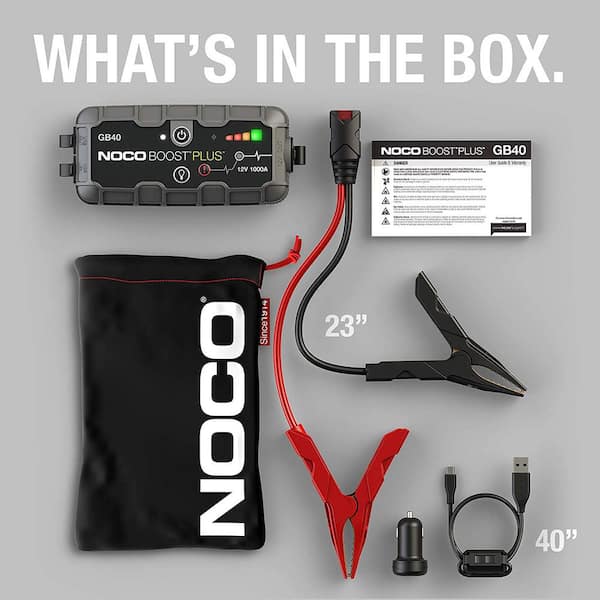
The NOCO GB40 focuses on jump-starting and basic emergency power. It has a bright LED light with several modes, including an emergency strobe and an SOS setting. It also has a USB output for charging a phone or other small device.
The GB40 does not include an air compressor. If you want one device for both a weak battery and a low tire, a Schumacher model with an inflator may offer better value.
Still, extra features can add weight and create more parts to maintain. An air compressor also uses a lot of energy. If you rarely need tire inflation, the smaller NOCO may be the more practical tool.
Real-World Starting Performance
On paper, the Schumacher Jump Starter vs NOCO GB40 comparison looks nearly even when both products show a 1,000-amp rating. Real-world results can differ because of battery age, cable contact, engine size, and weather.
A healthy four-cylinder engine with a weak battery is the easiest case. Both packs should have a good chance of starting it when fully charged and connected correctly.
A large engine with a flat battery is more demanding. The starter motor may need high current for longer, and a small lithium pack can lose voltage quickly. In this situation, a higher-capacity Schumacher model may be a better fit than the SJ1332.
One lesson I would give any driver is to clean the battery posts before judging a jump starter. I have seen people blame the pack when the real problem was thick corrosion between the clamp and terminal. A firm metal connection often matters as much as the printed amp rating.
Use these practical tips:
• Wait one to two minutes after connecting the pack before cranking.
• Turn off lights, climate control, radio, and other accessories.
• Make sure the clamps grip clean metal.
• Do not crank for more than a few seconds at a time.
• Let the pack rest between attempts.
If the engine does not start after several careful attempts, stop. The vehicle may have a fuel, ignition, starter, or mechanical problem.
Durability and Weather Resistance
The NOCO GB40 has an IP65-rated housing. This means it is protected from dust and water jets, but it is not designed for underwater use. Its rugged case is one reason it works well in a roadside emergency kit.
Schumacher durability depends on the model. Some units have tough plastic cases and protected controls, while others are designed more for occasional home use. If you drive on rough roads or work outdoors, inspect the case, cable strain relief, and clamp hinges before buying.
Neither unit should be treated as indestructible. Keep the pack away from standing water, engine heat, fuel, and sharp tools. Do not use it if the battery case is damaged.
The NOCO GB40 has an advantage in published weather protection. Schumacher may win in utility, but you must check the exact product specifications rather than assume every Schumacher jump starter has the same protection.
Warranty and Long-Term Value
Warranty coverage can influence the Schumacher Jump Starter vs NOCO GB40 decision. NOCO lists a limited two-year warranty for the GB40, subject to its terms and exclusions.
Schumacher warranty length varies by product and seller. Some models include a limited warranty, but the coverage period and claim process may differ. Keep the receipt and record the model number after purchase.
Price also changes often. A Schumacher unit may cost less while adding an air compressor or power outlet. The NOCO GB40 may cost more for its compact design, brand support, safety system, and water-resistant construction.
Consider total value rather than only the sale price:
• How often will you carry it?
• Do you need an air compressor?
• Is the warranty easy to use?
• Can you replace the charging cable?
• Does the pack fit your engine size?
• Will you remember to keep it charged?
A bargain is not a bargain if the battery fails after sitting unused or the device cannot meet your vehicle’s needs.

Which One Should You Buy?
The best choice in the Schumacher Jump Starter vs NOCO GB40 comparison depends on your vehicle and habits.
Choose the NOCO GB40 if:
• You want a compact jump starter.
• You drive a normal car, crossover, motorcycle, or small truck.
• You value a simple interface and clear safety alerts.
• You want IP65 water and dust protection.
• You do not need an air compressor.
Choose a Schumacher jump starter if:
• You want more features in one device.
• You need an air compressor for tire emergencies.
• You drive a larger truck, boat, or recreational vehicle.
• You prefer a larger battery or stronger model.
• You find a model with better value for your budget.
For most everyday drivers, the NOCO GB40 is the safer simple pick. For drivers who want a multi-tool for roadside problems, Schumacher often offers more flexibility.
Before ordering, compare the exact Schumacher model number with your vehicle’s engine size. This step prevents one of the most common buying mistakes: comparing a 1,000-amp Schumacher model with a larger Schumacher model and assuming they perform the same.
How to Use Either Jump Starter Safely
A jump starter is powerful equipment. Treat it with care and follow the manual for your exact model.
Use this basic process:
-
Park safely and engage the parking brake.
-
Turn off the engine and all electrical accessories.
-
Inspect the battery for cracks, leaks, or severe damage.
-
Connect the positive clamp first.
-
Connect the negative clamp to the correct point.
-
Activate the pack if required.
-
Start the vehicle for no more than a few seconds.
-
Once the engine runs, remove the clamps carefully.
-
Recharge the jump starter soon after use.
Never use a portable jump starter on a frozen battery. A frozen battery can crack and leak acid. If you smell strong sulfur, see smoke, or notice heat at the cables, stop immediately.
Do not connect the jump starter to a vehicle with a voltage system that does not match the product. The NOCO GB40 and many Schumacher consumer models are designed for 12-volt systems, not 24-volt commercial systems.
Schumacher Jump Starter vs NOCO GB40: Common Buying Mistakes
Many jump starter problems come from poor preparation, not poor products.
Avoid these mistakes:
• Buying from peak amps alone: Peak current is only one part of starting performance.
• Ignoring engine size: A large diesel needs more reserve than a small gasoline engine.
• Leaving the pack uncharged: Check the battery gauge before every long drive.
• Storing it in extreme heat: High temperatures reduce lithium battery life.
• Choosing a model without checking accessories: Some Schumacher products include an inflator, while others do not.
• Using damaged clamps: Bent jaws and worn cables can create poor contact.
• Expecting it to repair a dead battery: A jump starter starts an engine; it does not fix the charging system.
A smart approach is to match the tool to your most likely emergency. If your main fear is a dead car battery, the NOCO GB40 may be enough. If you also worry about low tires, camping power, or roadside lighting, a Schumacher multi-function model may make more sense.
Schumacher Jump Starter vs NOCO GB40: Frequently Asked Questions
Is the Schumacher Jump Starter better than the NOCO GB40?
Neither is best for every driver. Schumacher often provides more features, while the NOCO GB40 offers a compact design, clear controls, and strong published safety features.
Can the NOCO GB40 start a diesel engine?
Yes, the NOCO GB40 is rated for diesel engines up to 3.0 liters. Actual performance depends on battery condition, temperature, engine health, and proper clamp contact.
Does every Schumacher jump starter include an air compressor?
No. Some Schumacher models include an air compressor, but others are jump-start-only devices. Check the exact model description before purchasing.
How long does the NOCO GB40 hold a charge?
The battery can hold charge for a long period when stored correctly, but it still needs periodic checks. Recharge it after use and inspect the charge level every few months.
Can a Schumacher jump starter charge a phone?
Many Schumacher models include USB charging ports, but the number and output can vary. Confirm the product specifications if phone charging is important to you.
Is the NOCO GB40 waterproof?
The NOCO GB40 has an IP65-rated housing, which protects it from dust and water jets. It should not be submerged or left exposed to heavy water for long periods.
Can either jump starter replace a battery charger?
No. A jump starter provides a short burst of energy to crank the engine. A battery charger is designed to restore the battery over a longer period.
Conclusion
The Schumacher Jump Starter vs NOCO GB40 decision comes down to simplicity versus versatility. The NOCO GB40 is compact, well protected, and easy to store, while Schumacher offers more model choices and may include useful tools such as an air compressor.
For a typical car, either can be a smart emergency purchase when correctly matched to the engine size. Check the exact ratings, keep the unit charged, and store it where you can reach it quickly. Compare current models and user reviews before buying, then share your experience with the Schumacher Jump Starter vs NOCO GB40 to help other drivers choose wisely.