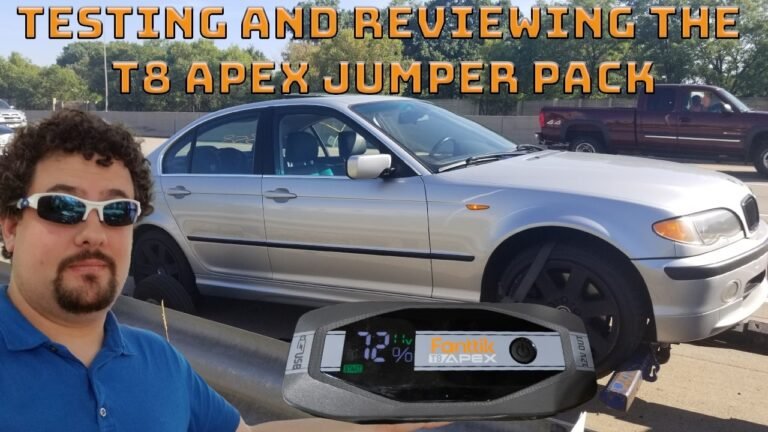
Tacklife T8 Vs NOCO GB40: Which Jump Starter Wins?
Tacklife T8 offers more features, while NOCO GB40 wins for compact design and proven reliability.
Choosing between the Tacklife T8 vs NOCO GB40 is not only about peak amps. It is also about battery size, safety, portability, charging speed, and the kind of roadside help you may need. This guide compares both jump starters in clear, practical terms so you can pick the right one for your car, truck, motorcycle, or emergency kit.
Tacklife T8 vs NOCO GB40 at a glance
The Tacklife T8 and NOCO GB40 are portable 12-volt jump starters. Both can start a weak car battery without another vehicle, but they take different approaches.
The Tacklife T8 focuses on extra tools. Many T8 versions include a larger battery, air compressor, USB charging ports, a screen, and a bright work light. The NOCO GB40 focuses on a small body, simple controls, strong safety features, and a well-known design.
Here is a simple comparison:
| Feature | Tacklife T8 | NOCO GB40 |
|---|---|---|
| Peak current | Usually rated at 1,200 amps | Rated at 1,000 amps |
| Battery capacity | Often listed around 18,000 mAh | Smaller internal battery, measured differently by the brand |
| Vehicle output | 12 volts | 12 volts |
| Gas engine rating | Commonly up to about 7.0 liters | Up to 6.0 liters |
| Diesel engine rating | Commonly up to about 5.5 liters | Up to 3.0 liters |
| Air compressor | Included on many T8 models | Not included |
| USB charging | Yes | Yes |
| Work light | Yes | Yes |
| Reverse-polarity protection | Yes | Yes |
| Water resistance | Varies by model and listing | IP65-rated housing |
| Best for | Feature-rich emergency use | Compact, simple jump starting |
Specifications can vary slightly by Tacklife T8 revision and seller listing. Always check the label and manual before buying, especially if you need the compressor or a specific engine-size rating.

Design and portability
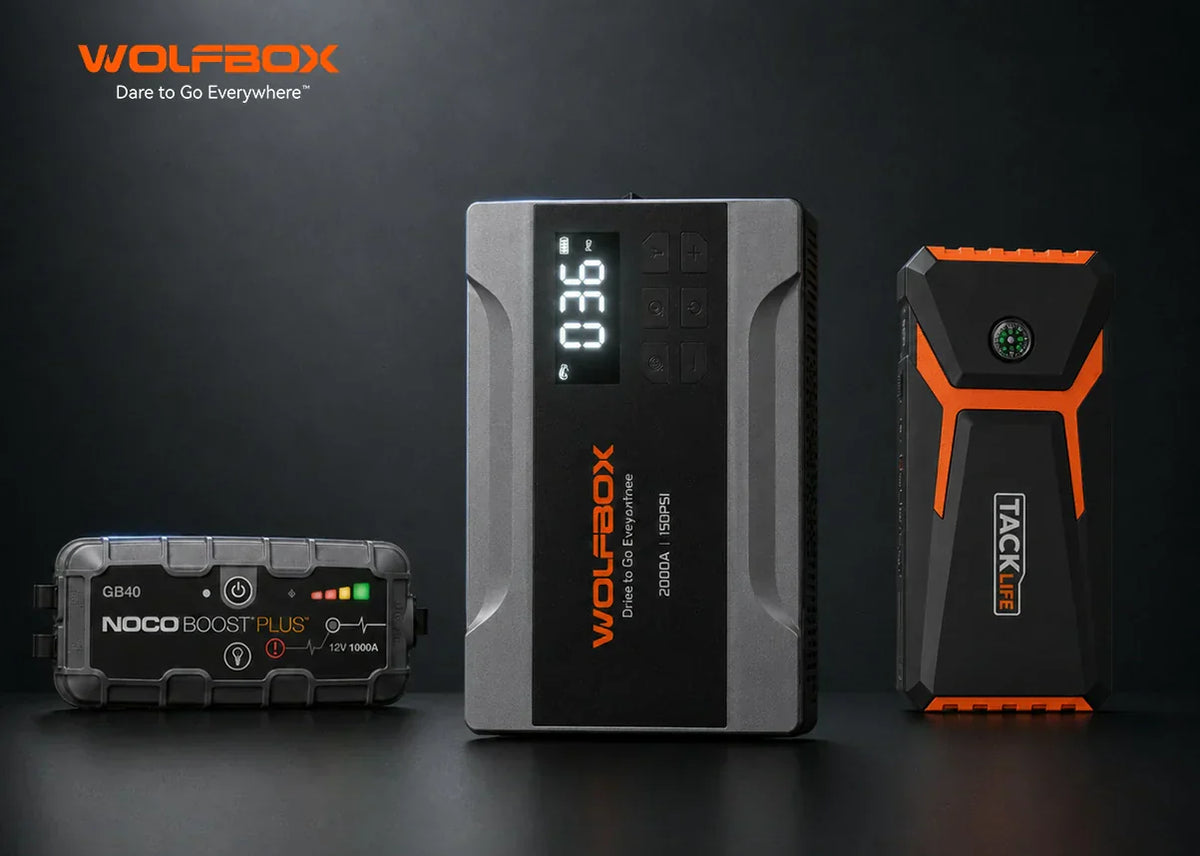
The NOCO GB40 is the easier unit to carry. It has a compact shape, protected buttons, and thick cables that store neatly around the body. It feels more like a dedicated emergency tool than a large battery pack.
The Tacklife T8 is usually larger and heavier. That extra size is understandable because it may include an air compressor, a display, more battery capacity, and extra ports. It can still fit in a trunk or under a seat, but it takes more room than the GB40.
For daily carry, the GB40 has the advantage. For a roadside kit, the larger T8 may be worth the space.
A useful way to think about it is this:
• The GB40 is like a compact fire extinguisher. It is ready for one main job.
• The T8 is more like a small roadside toolbox. It can jump-start a battery and handle several other tasks.
Jump-starting performance
The most important part of the Tacklife T8 vs NOCO GB40 comparison is starting power. A jump starter must deliver enough current for the starter motor while the battery is weak.
The Tacklife T8 is commonly advertised with a 1,200-amp peak rating. The NOCO GB40 has a 1,000-amp peak rating. On paper, the T8 has the higher number.
Peak amps are not the whole story, though. A peak figure is a short burst, not a constant output rating. Cable quality, battery temperature, engine size, battery condition, and connection quality all affect real-world performance.
Both units are best suited to healthy vehicles with drained or weak batteries. Neither should be treated as a cure for a failed battery, damaged starter, bad alternator, or corroded cable.
Which one starts larger engines?
The Tacklife T8 usually has the higher listed engine range. Some versions claim support for gasoline engines around 7.0 liters and diesel engines around 5.5 liters.
The NOCO GB40 is generally rated for gasoline engines up to 6.0 liters and diesel engines up to 3.0 liters. That makes the T8 more attractive for larger trucks, SUVs, vans, and some diesel vehicles.
These ratings are not guarantees. A cold diesel engine with a badly discharged battery may need far more effort than a warm gasoline engine with a mildly weak battery.

Battery capacity and recharge time
The Tacklife T8 often lists an 18,000 mAh battery. This gives it a strong reserve for repeated jump attempts, phone charging, and other emergency tasks.
The NOCO GB40 uses a smaller, tightly integrated battery pack. Its capacity is not always presented in the same way as the Tacklife rating, so comparing milliamp-hours alone can be misleading. Battery voltage and watt-hours matter too.
The T8 may offer more backup power, but a larger battery can also take longer to recharge. The GB40 is simpler to maintain, but it still needs regular charging if it sits in a vehicle for months.
For best results:
-
Charge the jump starter before storing it.
-
Check its charge every one to three months.
-
Recharge it after every jump-start attempt.
-
Do not leave it in extreme heat for long periods.
-
Keep the charging cable with the unit.
Lithium batteries lose charge faster in very cold weather. If you live in a cold state, store the unit indoors when possible and keep it warm before use.
Air compressor and extra features
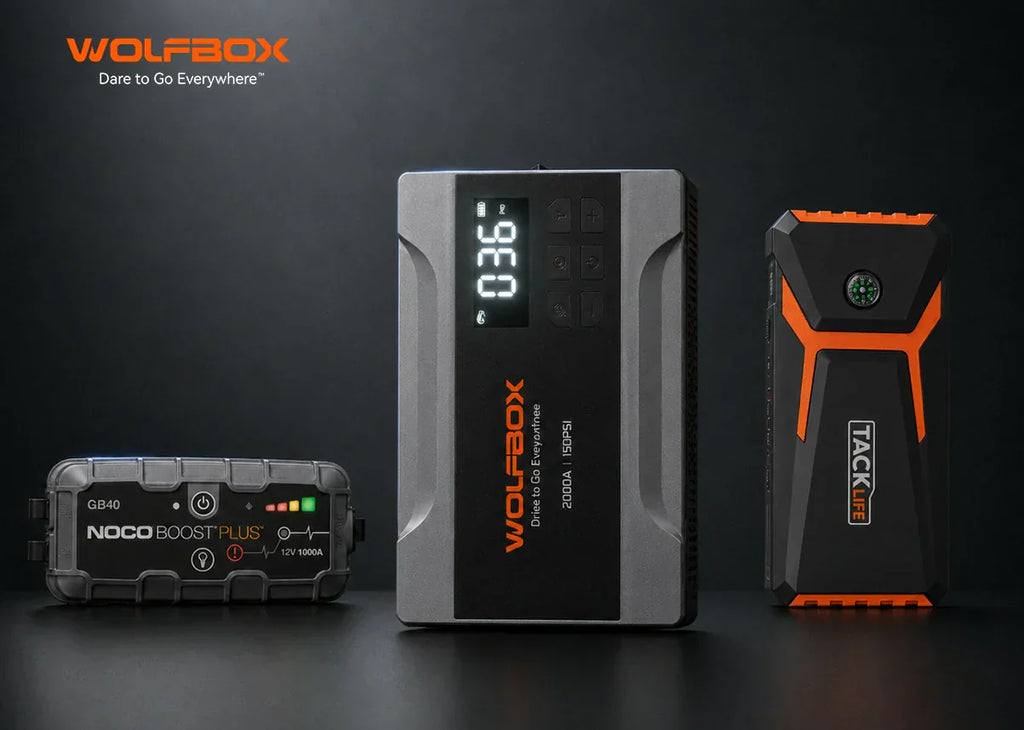
The built-in compressor is the biggest feature difference in the Tacklife T8 vs NOCO GB40 matchup. Many Tacklife T8 versions include a 12-volt air compressor with a digital display and preset pressure controls.
This can help with a slow tire leak or low tire pressure. It is useful after a temperature drop, before a long road trip, or when a gas station air pump is not nearby.
The compressor is not designed to repair a puncture. It may also run slowly on large truck tires. Use it for topping up air, not as a replacement for a full-size workshop compressor.
The NOCO GB40 does not include an air compressor. Instead, it keeps the design smaller and puts its space into jump-starting hardware, safety controls, USB power, and a work light.
Common Tacklife T8 features include:
• Digital battery or pressure display
• USB charging ports
• Quick-charge support on some versions
• 12-volt accessory output
• LED flashlight with emergency modes
• Air compressor
Common NOCO GB40 features include:
• USB power output
• LED flashlight
• Hazard and strobe modes
• Manual override for some difficult battery conditions
• Spark-proof connection design
• Reverse-polarity warning
The exact feature list depends on the product revision. Read the manual rather than relying only on a marketplace title.

Safety and ease of use
A jump starter is a high-current device, so safety matters more than a small difference in amp ratings. Both the Tacklife T8 and NOCO GB40 are designed to reduce common connection mistakes.
Helpful safety features may include:
• Reverse-polarity protection
• Short-circuit protection
• Overcharge protection
• Over-current protection
• Spark-resistant clamps
• Low-voltage warning
The NOCO GB40 is especially easy for new users. The clamps connect to the battery, and the unit provides clear light and button signals. Its controls are simple, which is useful when you are standing beside a car in rain or darkness.
The Tacklife T8 may offer more information through a screen. That can help when checking charge level or tire pressure. However, more controls can also mean more steps for a first-time user.
Always follow this basic order:
-
Turn off the vehicle.
-
Connect the red clamp to the positive battery terminal.
-
Connect the black clamp to the negative terminal or a clean metal ground.
-
Turn on the jump starter if the manual requires it.
-
Start the vehicle for no more than a few seconds.
-
Remove the clamps in reverse order.
Never connect the clamps by color alone if the battery terminals are unclear. Look for the plus and minus symbols.

Performance in cold weather
Cold weather is hard on car batteries. The battery produces less starting power, while the engine oil becomes thicker. That means the jump starter must work harder.
The Tacklife T8 may have an advantage when its larger battery and higher peak rating are useful. It also offers more reserve for repeated attempts.
The NOCO GB40 is still a strong choice for normal passenger vehicles. Its compact lithium battery and safety system make it convenient for winter emergencies, but it should be kept charged and protected from deep cold.
Neither unit should be stored outside in freezing temperatures for long periods. Bring the jump starter indoors when possible. Allow it to warm up before charging if it has been exposed to severe cold.
If the car does not start after a few short attempts, stop. A jump starter cannot solve problems such as frozen fuel, a failed starter motor, or a damaged electrical system.

Charging phones and other devices
Both units can serve as emergency power banks. The Tacklife T8 usually provides more charging flexibility because of its larger battery and multiple output options.
The NOCO GB40 can charge small USB devices, such as a phone, GPS unit, or wireless earbuds. Its main purpose remains vehicle starting, so its USB output is more limited than a dedicated power bank.
The T8 is more useful on long trips. You can use it to top up a phone, power a small accessory, or inflate a tire. Still, do not drain the battery on electronics before you need to start the car.
A good habit is to charge your phone from the jump starter only after the vehicle is running or when you have another emergency power source.
Real-world reliability and maintenance
The best jump starter is the one that works when the car does not. In practice, storage habits often matter as much as brand choice.
The NOCO GB40 has a strong reputation for simple operation and a durable compact design. It is a popular pick for drivers who want a dedicated jump starter from an established automotive-accessory brand.
The Tacklife T8 can provide more value when its extra features are important. Yet Tacklife product listings and model revisions can vary. Check warranty terms, included accessories, clamp condition, and the exact battery specification before purchase.
One lesson that applies to both models is simple: do not leave a jump starter forgotten in the trunk for years. Lithium batteries age even when they are not used.
Before a road trip, inspect:
• Battery charge level
• Clamp insulation
• Cable connections
• Charging port covers
• Compressor hose and fittings
• Flashlight operation
• Storage case or cable clips
If the unit becomes swollen, unusually hot, cracked, or damaged, stop using it. Replace it through a safe battery-recycling program.

Tacklife T8 vs NOCO GB40: pros and cons
Tacklife T8 pros
• Higher advertised peak current
• Larger listed battery capacity
• Built-in air compressor on many versions
• Useful screen and pressure controls
• Better fit for larger engines and roadside tasks
• More charging and accessory functions
Tacklife T8 cons
• Larger and heavier
• Longer recharge time may be possible
• Feature list varies by model revision
• Compressor use can drain the battery quickly
• Quality and warranty support may depend on the seller
NOCO GB40 pros
• Small and easy to store
• Simple operation
• Strong safety features
• Durable, protected design
• Good choice for most cars and small SUVs
• No need to carry a separate compressor for jump starting
NOCO GB40 cons
• Lower advertised peak current than the T8
• No built-in air compressor
• Smaller reserve for repeated tasks
• Less useful as a general roadside power station
• Diesel capacity is more limited
Which jump starter should you buy?
Choose the Tacklife T8 if you want one device for several roadside jobs. It makes sense for drivers who want an air compressor, larger battery capacity, higher listed peak current, and support for larger engines.
Choose the NOCO GB40 if you want a compact unit that is easy to use and easy to store. It is a better fit for most sedan, coupe, crossover, and small SUV owners who mainly need emergency jump-start power.
The Tacklife T8 is also a practical choice for rural drivers, long-distance travelers, and families who want more backup tools in one case. The NOCO GB40 is ideal for a glovebox, trunk organizer, or small roadside emergency kit.
Before buying, ask yourself:
• Do I need an air compressor?
• Do I drive a diesel or large engine?
• Will I carry the unit often?
• Do I prefer simple controls?
• Can I verify the exact model and warranty?
For a large diesel truck, compare both units with models designed for heavy-duty use. A bigger jump starter may be safer than repeatedly pushing a small unit beyond its intended range.
How to use either jump starter safely
Read the manual first. Product controls and connection steps can differ between revisions.
Use these general safety rules:
-
Inspect the battery for cracks, leaks, or severe damage.
-
Do not jump a frozen, swollen, or leaking battery.
-
Turn off lights, climate controls, radios, and other accessories.
-
Make sure the clamps have a clean, firm connection.
-
Keep the clamps from touching each other.
-
Do not crank the engine for more than a few seconds at a time.
-
Wait between attempts so the unit and starter can cool.
-
Disconnect the clamps after the vehicle starts.
-
Let the vehicle run or drive for a while to restore some battery charge.
A jump starter can get you moving, but it does not fully recharge a car battery. If the battery repeatedly dies, have the battery and charging system tested.
Frequently Asked Questions
Is the Tacklife T8 more powerful than the NOCO GB40?
The Tacklife T8 is usually advertised at 1,200 peak amps, while the NOCO GB40 is rated at 1,000 amps. That gives the T8 a higher stated peak output, but real starting results also depend on temperature, battery condition, engine size, and cable connection.
Is the NOCO GB40 better than the Tacklife T8?
The NOCO GB40 is better for drivers who value compact size, simple controls, and dependable jump-start functions. The Tacklife T8 is better when you want an air compressor, larger battery capacity, and more roadside features.
Can the Tacklife T8 jump-start a diesel truck?
Many Tacklife T8 listings claim support for diesel engines up to about 5.5 liters, but the exact rating can vary by revision. Check the manual and compare the rating with your truck’s engine size before relying on it.
Can the NOCO GB40 jump-start a completely dead battery?
The NOCO GB40 can work with a deeply discharged battery in some cases, but it may need its manual override feature. Use that mode only when the manual allows it, because some automatic safety protections may be reduced.
Does the Tacklife T8 include an air compressor?
Many Tacklife T8 versions include a built-in compressor, often with a digital pressure display. Confirm the exact listing before buying because accessories and specifications can differ between model versions.
How often should I charge the Tacklife T8 or NOCO GB40?
Check the charge every one to three months and recharge the unit after use. Regular checks help prevent the common mistake of discovering an empty jump starter during an emergency.
Can either jump starter replace a car battery charger?
No. A jump starter supplies a short burst of power to start the engine, while a battery charger restores the battery over a longer period. If your battery keeps losing power, find and repair the underlying fault.
Conclusion
The Tacklife T8 vs NOCO GB40 decision comes down to priorities. The Tacklife T8 offers more power on paper, a larger battery, and useful extras such as an air compressor. The NOCO GB40 is smaller, simpler, and better suited to drivers who want reliable emergency starting without extra bulk.
For larger engines and broader roadside use, the Tacklife T8 is the more versatile choice. For compact storage and straightforward operation, the NOCO GB40 remains a strong option.
Check the exact specifications, keep your chosen unit charged, and test its accessories before an emergency happens. Explore your vehicle’s battery needs, compare current model listings, and share your experience with the Tacklife T8 or NOCO GB40 in the comments.